
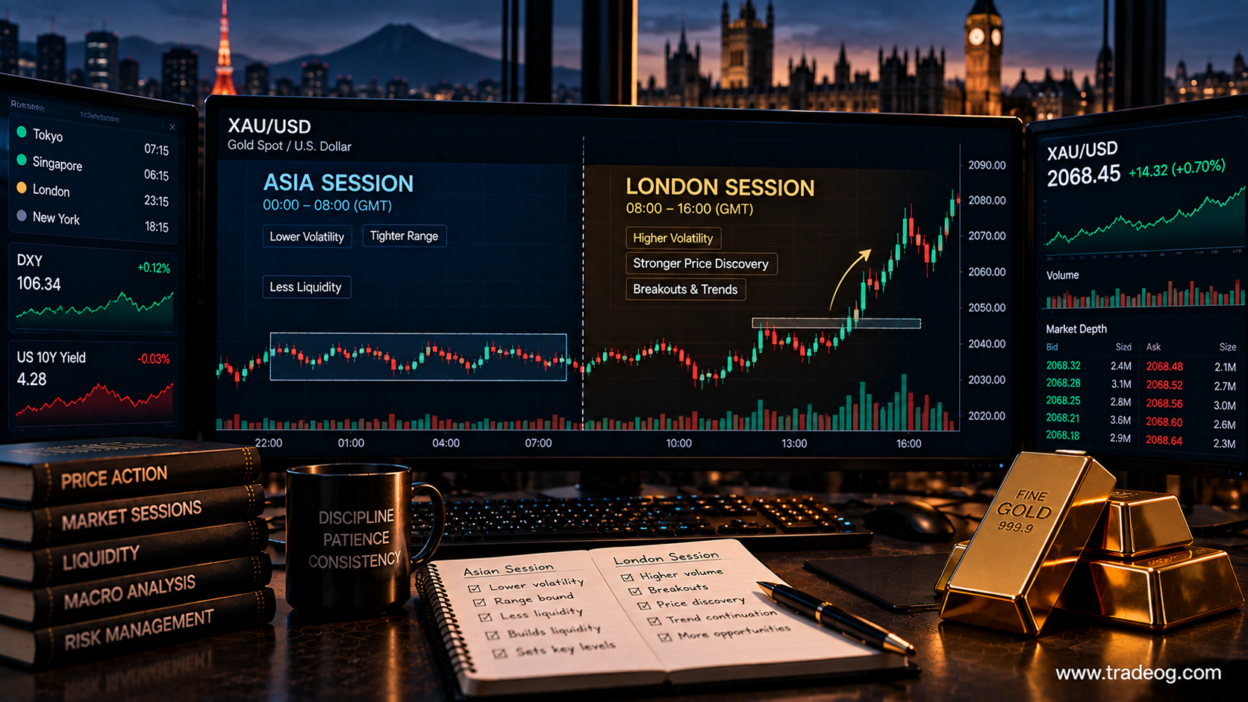
Quick answer: Gold does not discover its price in exactly the same way throughout the trading day. During Asian hours, XAU/USD can spend more time building ranges, absorbing regional demand and reacting to developments from the previous US session. As London comes online, the market gains another major pool of institutional participation, OTC activity and liquidity. That can turn an Asian range into a breakout, a continuation move or, sometimes, a sharp reversal.
This does not mean the Asian session is simply “slow” and London is always “better.” Gold is a global market, and price discovery can happen in every major centre. The more useful way to think about the sessions is that different participants, liquidity conditions and information flows can change how price discovers the next tradable level.
That distinction is becoming even more relevant. The World Gold Council’s 2026 research notes the growing role of Asian markets in gold price discovery and found that, during the first half of 2026, many gold rebounds occurred during Asian hours while many pullbacks occurred during US hours. The Council also identifies London, the US futures market and Shanghai as the three major global gold trading centres. World Gold Council’s 2026 Mid-Year Outlook provides the broader market context.
What Does “Price Discovery” Mean in Gold?
Price discovery is the process through which buyers and sellers interact to establish the price at which the market is willing to transact.
For XAU/USD traders, you can think of it as a continuous negotiation:
- Buyers decide how much they are willing to pay.
- Sellers decide how much they are willing to accept.
- New information changes those decisions.
- Liquidity determines how easily orders can be matched.
- Price moves until enough buying and selling interest meets.
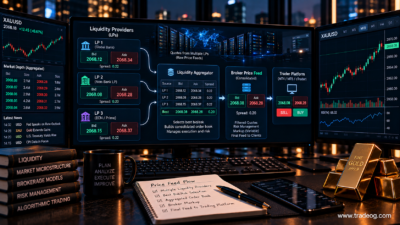
Gold is unusual compared with a single-stock market because there is no single global exchange that contains every transaction. The wholesale market includes OTC trading as well as futures and other exchange-traded venues. The World Gold Council estimates that the London OTC market remains a major global centre, while COMEX and the Shanghai Gold Exchange are also important to price discovery. Gold market structure and global trading hubs explains how these venues interact.
Why the Asian Session Can Build the First Price Range
Asian trading is not simply a period when nothing happens.
Tokyo, Shanghai, Hong Kong, Singapore and other regional participants can contribute meaningful buying and selling interest. Asian investors and consumers have also become increasingly important to the gold market.
The result can be a period in which XAU/USD establishes a reference range before European participation increases.
For an intraday trader, that range can become important because later participants see the same highs, lows and consolidation boundaries.
For example, suppose gold spends several hours trading between $2,030 and $2,040 during Asia. By the time London opens, those levels are visible on many charts.
London traders do not have to respect the range. But they now have a clearly established reference point from which the next price discovery phase can begin.
Asian Price Discovery Is Increasingly Important
One reason traders should avoid treating Asia as merely a “range-building session” is the changing structure of the global gold market.
The World Gold Council reported in its 2026 Mid-Year Outlook that Asian markets have become increasingly relevant to gold price discovery. Its intraday analysis found that the bulk of gold’s moves in the first half of 2026 were linked to Asian and US trading hours, with rebounds generally occurring during Asian hours and many pullbacks during US hours.
The Council’s Q2 2026 research also reported strong OTC activity associated with Asian investment and said Asian investment was expected to contribute increasingly to gold demand through the rest of 2026. Gold Demand Trends Q2 2026 outlook provides the latest published context.
So the better model is not:
Asia = no price discovery.
It is:
Asia can establish, extend or challenge the market’s current valuation before London introduces another major wave of participation.
What Changes When London Opens?
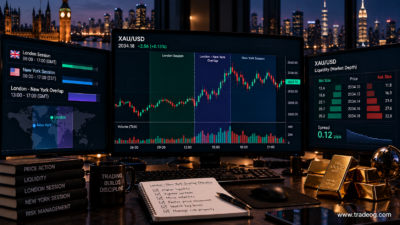
London is historically one of the most important centres in the wholesale gold market. The London OTC market has long played a central role in global gold trading, and the LBMA Gold Price provides a widely used reference benchmark.
When European participants become active, the market receives another major source of orders and information. That can change:
- Liquidity
- Trading volume
- Spread conditions
- Volatility
- Order-flow balance
- Breakout probability
- Reaction to Asian highs and lows
This is why a quiet Asian range can suddenly become very active around the London session.
However, increased participation does not guarantee a bullish or bearish move. London can break the Asian high, break the Asian low, reverse both sides, or simply continue consolidating.
Asian Session vs London Session: The Main Difference
| Factor | Asian session | London session |
|---|---|---|
| Market participation | Strong regional participation | Large European institutional participation joins |
| Typical intraday structure | Often range-building, but not always | More frequent range expansion and repricing |
| Liquidity | Can vary significantly by time and venue | Often increases as European markets become active |
| Key reference levels | Asian high, low and range | Asian range plus London highs/lows |
| Price discovery | Regional demand, overnight information and global flows | European participation plus new information and positioning |
| Common trader mistake | Assuming a quiet range cannot break | Assuming the London breakout must continue |
1. London Often Tests the Asian Range
One of the most familiar XAU/USD patterns is a London move through an Asian-session extreme.
Suppose Asia establishes:
High = $2,040
Low = $2,030
London then opens and pushes above $2,040.
That move can mean several different things.
- A genuine bullish breakout
- A liquidity sweep followed by reversal
- A temporary volatility expansion
- The beginning of a larger trend
- A breakout that later waits for New York confirmation
The important point is that the Asian high is a reference level, not a guaranteed resistance level.
TradeOG’s guide on XAU/USD Asian session behaviour explains how these ranges can develop, while the guide on XAU/USD London session behaviour covers what can happen when European participation arrives.
2. A London Breakout Has More Information Behind It — But Still Needs Confirmation
A common mistake is to assume that the London open automatically creates a real trend.
It does not.
A larger market move can occur because more orders are entering the market, but the direction still depends on the balance between buyers and sellers.
For example, gold may break above the Asian high, attract breakout buyers and then fail within 15 minutes. Alternatively, it may break the high, pull back to the breakout area, hold, and continue higher.
The second sequence tells you more about price acceptance.
This connects directly with TradeOG’s recent article on why XAU/USD can sweep a previous high before continuing higher.
3. The First London Move Can Be a Repricing of the Asian Range
Think of the Asian session as establishing a temporary map of where the market has recently been comfortable trading.
London can then challenge that map.
If European buyers believe gold is undervalued relative to the information available to them, price can move above the Asian range. If sellers disagree, the breakout can fail.
This is why the first London move can be so informative even when it does not become a trend.
It tells you that the balance of orders has changed.
4. News Can Completely Override the Session Structure
Session behaviour should never be treated as more important than major information.
A geopolitical headline, central-bank communication, inflation report or unexpected macroeconomic development can change gold’s valuation regardless of whether the market is in Asia or London.
Similarly, the market can enter London already carrying a strong directional move from Asia.
In that situation, London does not necessarily need to “create” the trend. It may simply extend the price discovery process that began earlier.
TradeOG’s article on distinguishing gold news volatility from a genuine trend explains why traders should separate a temporary volatility burst from sustained market structure.
5. Watch What Happens to the Asian High and Low
For intraday XAU/USD traders, the Asian range is useful because it creates two visible reference points.
Mark:
- Asian session high
- Asian session low
- Asian session midpoint
- Previous day’s high
- Previous day’s low
- Nearby higher-timeframe support and resistance
Then observe the London reaction.
Break and hold above Asian high: bullish acceptance becomes more credible.
Break Asian high and quickly return inside: failed breakout or liquidity sweep becomes more plausible.
Break Asian low and hold below: bearish continuation becomes more credible.
Break one side and reverse through the entire range: volatility and two-way liquidity may be dominating directional conviction.
These are observations, not guarantees.
6. Price Discovery Is Not the Same as Volatility
A market can become more volatile without discovering a sustainable new price.
For example, XAU/USD might move from $2,035 to $2,045 and then return to $2,035.
That is a large amount of movement, but the market did not necessarily accept $2,045 as the new value area.
Conversely, gold could move gradually from $2,035 to $2,042, consolidate around $2,040 and then continue higher. The move is less dramatic but may represent stronger price acceptance.
The distinction is important for traders who automatically equate larger candles with better trends.
7. Liquidity Can Change the Way Breakouts Behave
Liquidity is not constant throughout the trading day.
The World Gold Council’s 2026 research found that gold remained deeply liquid overall, but bid-ask spreads widened episodically during periods such as off-market hours and stress. Its data also show the scale of trading across OTC, futures and ETF markets.
World Gold Council’s 2026 liquidity research is useful when thinking about why execution conditions can change even though gold trades globally.
For a retail XAU/USD trader, the practical lesson is simple: a breakout during one session may not behave the same way as a breakout during another session because the surrounding liquidity and participation are different.
8. Why London Can Turn a Range Into a Trend
A range becomes a trend when the market stops accepting the old balance and begins accepting prices in a new direction.
Consider this sequence:
- Asia builds a range.
- London breaks above the Asian high.
- Price does not immediately fall back into the range.
- The old high becomes support.
- A higher low forms.
- Gold makes a fresh high.
That sequence is more convincing than a single breakout candle.
It suggests that buyers are willing to transact above the previous Asian range.
9. Why London Can Also Fail to Create a New Trend
There are days when London simply extends the range.
This can happen when:
- The market is waiting for US data.
- Macro expectations are balanced.
- Gold is near major higher-timeframe resistance.
- Asian buying already moved price substantially.
- Participants are reducing risk before a major event.
- There is insufficient directional conviction.
On those days, trying to force a London breakout trade can be less effective than recognising that the market remains balanced.
10. What Indian XAU/USD Traders Should Watch
For traders in India, session analysis is especially useful because London and New York activity occurs during the afternoon and evening in IST, with exact clock times shifting seasonally because of daylight-saving changes in other regions.
Instead of memorising one fixed “London open” time for the entire year, use the actual session time for the relevant date.
Then build a simple routine:
- Mark the Asian high and low.
- Mark the previous day’s high and low.
- Check major economic events.
- Identify the higher-timeframe direction.
- Watch the first London reaction.
- Wait for acceptance or rejection.
- Only then evaluate a trade setup.
This approach is more robust than assuming London is always bullish or always volatile.
Asian Range vs London Expansion: A Practical Example
Imagine XAU/USD trades between $2,030 and $2,038 during Asia.
London opens and pushes gold to $2,043.
A trader sees the breakout and immediately buys.
Five minutes later, gold falls back to $2,037.
The trader now assumes the breakout was fake.
But then gold holds $2,037–$2,038, forms a higher low and pushes back above $2,043.
The first move was not necessarily a failed breakout. The market was simply testing whether the new price area would be accepted.
Now imagine the opposite:
Gold breaks $2,038, reaches $2,043 and then collapses to $2,032. The entire London breakout has been rejected.
Same Asian range. Same first breakout. Completely different price discovery outcome.
The reaction after the breakout is what matters.
How to Read the Asian-to-London Transition
A simple framework is to classify the transition into four conditions.
| London behaviour | Interpretation | What to watch |
|---|---|---|
| Breaks Asian high and holds | Potential bullish expansion | Retest and higher low |
| Breaks Asian high and rejects | Possible failed breakout | Return into range |
| Breaks Asian low and holds | Potential bearish expansion | Retest and lower high |
| Breaks both sides | Two-way volatility | Wait for structure |
This framework deliberately avoids predicting the market before it provides evidence.
What Traders Should Not Assume
“Asian session is always low liquidity.”
Liquidity varies by instrument, time and venue. Asian participation in gold is increasingly important, and global gold liquidity can remain substantial across the day.
“London always breaks the Asian range.”
No. London can trend, reverse, consolidate or wait for New York.
“A break of the Asian high means buy.”
A breakout needs context and confirmation. A failed breakout can move in the opposite direction quickly.
“The London session is more important than Asia.”
London remains a major global centre, but recent research shows that Asian markets are increasingly influential in gold price discovery.
“Price discovery means institutional manipulation.”
Price discovery is simply the process by which market participants interact and establish tradable prices. It does not require a manipulation narrative.
A Simple Daily Gold Session Routine
If you trade XAU/USD intraday, you can make session analysis part of your pre-trade routine:
- Before Asia: note the previous day’s high, low and major macro levels.
- During Asia: observe whether gold trends, consolidates or reacts to new information.
- Before London: mark the Asian high and low.
- At London: watch whether price expands beyond the Asian range.
- After the first move: wait for a retest, rejection or continuation structure.
- Before New York: reassess the move against US data, DXY, Treasury yields and the higher timeframe.
This turns session analysis from a vague idea into a repeatable process.
Final Takeaway
Gold price discovery changes between Asian and London sessions because the market is not driven by one group of traders or one venue. Different regional participants, liquidity conditions, information flows and positioning interact throughout the day.
Asia can establish an important price range and increasingly contribute to the direction of gold itself. London then introduces another major centre of wholesale activity and can expand, reject or completely reshape that range.
For XAU/USD traders, the key lesson is not to label one session as “good” and the other as “bad.” Instead, watch how the market transitions:
Asian range → London test → acceptance or rejection → new market structure.
That sequence gives you a much clearer framework for understanding price discovery than simply memorising session opening times.
FAQs
Does gold usually move differently in Asia and London?
Yes. The participation mix, liquidity and information flow can differ between sessions. Asian hours can establish important ranges and directional moves, while London often brings additional European participation and can expand or challenge those levels.
Is the Asian session important for XAU/USD?
Yes. Asian markets have become increasingly relevant to global gold price discovery. Recent World Gold Council research highlights the growing contribution of Asian activity and investment to the gold market.
Why does London often break the Asian high or low?
The Asian range provides visible reference levels. When European participation increases, new orders can challenge those levels. The resulting move may become a breakout, reversal or liquidity sweep.
Does a London breakout guarantee a gold trend?
No. Price can break the Asian range and then return inside it. Traders should look for follow-through, level acceptance and market structure rather than treating the first breakout candle as confirmation.
What should Indian traders mark before London opens?
Mark the Asian high and low, previous-day high and low, major support and resistance, and the day’s important economic events. Then observe how XAU/USD behaves when European participation increases.
Is London more important than Asia for gold trading?
Not necessarily. London remains a major global gold trading centre, but Asian markets are increasingly influential in gold demand and price discovery. The importance of each session also depends on the day’s information flow and market conditions.