

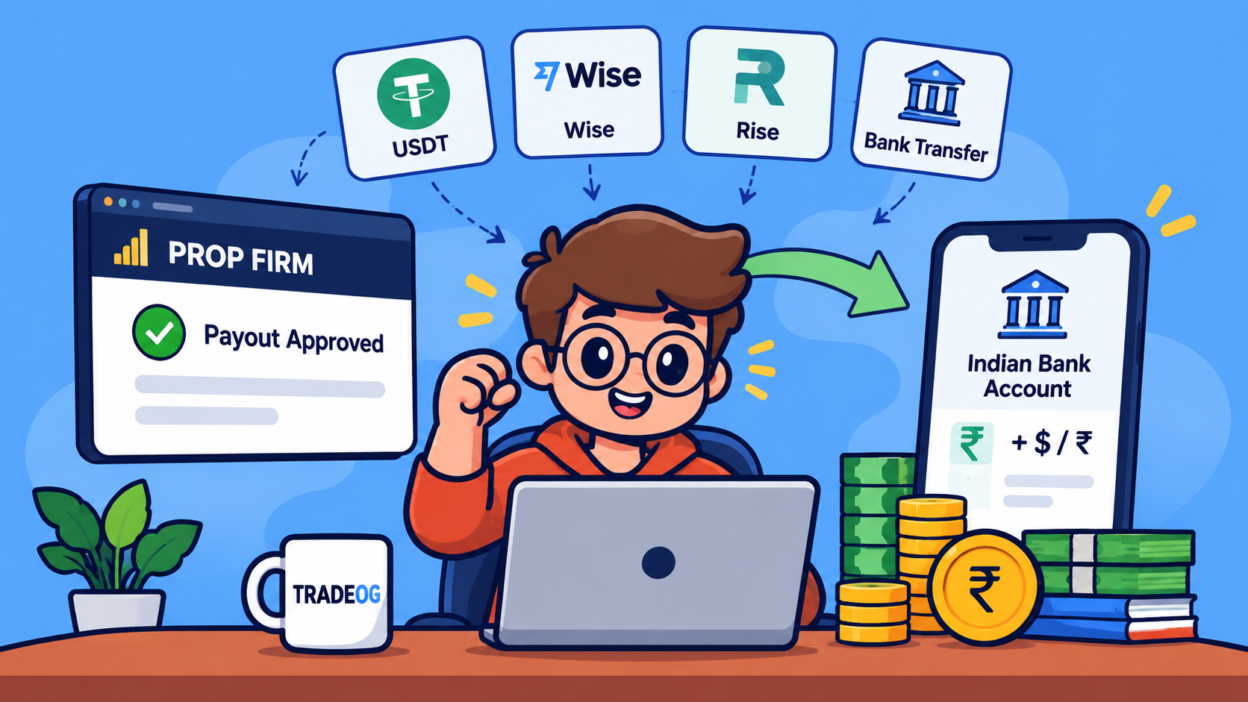
For many Indian traders, passing a prop firm challenge is only half the process. The next question is simple: how do you actually receive a prop firm payout in India?
In 2026, prop firms may offer different payout routes, including bank transfers, payment platforms, and cryptocurrency such as USDT. The exact options depend on the firm, the trader’s account, the payout provider, and the country where the trader is located.
This guide explains the common prop firm payout process for Indian traders, what documents may be requested, how currency conversion works, and what you should check before requesting a payout.
How Does a Prop Firm Payout Work?
A prop firm payout normally starts after you meet the firm’s payout conditions. These can include a minimum number of trading days, a minimum profit amount, a consistency rule, a withdrawal window, or other account-specific requirements.
After the payout request is approved, the firm sends the eligible amount through one of its supported payment methods. The amount you finally receive in India can differ from the headline payout because of profit splits, payment fees, currency conversion, or bank charges.
Common Prop Firm Payout Methods for Indian Traders
1. Bank Transfer
Some firms or payment providers can send funds through banking channels. A bank transfer can be useful when you want the payment to arrive directly in an Indian bank account and you want a clear transaction record.
Before requesting a transfer, check the firm’s supported currencies, beneficiary requirements, processing time, intermediary-bank charges, and whether the payment provider supports Indian residents.
2. USDT or Other Crypto Payouts
Some prop firms offer cryptocurrency payouts, commonly USDT. This can be convenient because the payout may not require a traditional international bank transfer from the prop firm.
However, a crypto payout creates additional steps. You need to use a compatible wallet or exchange, verify the network carefully, and maintain records of the transaction. Do not assume that a USDT payout is automatically tax-free or outside Indian reporting requirements.
For a deeper comparison, see our guide on prop firm payouts in USDT for Indian traders.
3. Wise
Wise may be available as a payout route for some firms or payment arrangements. Whether it works for a specific prop firm depends on the firm’s current payout process and Wise’s applicable terms.
Before selecting Wise, confirm the receiving details, supported currency, fees, identity requirements, and whether the payment is accepted for your specific payout arrangement. Read our guide to prop firm payouts through Wise for more detail.
4. Rise and Other Payment Platforms
Some trading and freelance-style payment ecosystems use specialist payout platforms such as Rise. Availability can change, so traders should always confirm the current method directly with the prop firm.
If Rise is offered by your firm, check account verification, supported withdrawal methods, conversion costs, and the final route into your Indian bank account. You can also read our guide to prop firm payouts through Rise.
What Documents May Indian Traders Need?
Payment providers and banks can request identity and transaction information before processing a payout. Common examples include:
- Government-issued identity document
- PAN and personal details
- Bank account information
- Proof of address, where required
- Payment account verification
- Payout statement or transaction record
Keep your payout emails, invoices or statements, account history, payment confirmations, bank credits, and relevant conversion records. Good documentation makes it easier to explain the source and movement of funds if a bank, payment provider, or tax professional asks for supporting information.
How Much Money Will You Receive?
Your requested payout is not always equal to the amount that reaches your Indian bank account. A simple example:
| Item | Example |
|---|---|
| Trading profit eligible for payout | $2,000 |
| Trader’s profit share | 80% |
| Gross trader payout | $1,600 |
| Conversion/payment charges | Varies |
| Final INR received | Depends on the exchange rate and charges |
This is only an example. Your actual split and fees depend on the prop firm’s terms and the payment provider.
How Does USD to INR Conversion Affect Your Payout?
Indian traders should look at the exchange rate as well as the payout amount. If a payout is denominated in USD, the INR amount can change because USD/INR moves over time.
There can also be a difference between the market exchange rate and the rate used by a bank or payment provider. Conversion fees and intermediary charges can reduce the amount credited to your account.
For a practical explanation, see USD to INR conversion for prop firm costs and payouts.
What About Tax on Prop Firm Payouts in India?
Tax treatment should not be decided only from the payment method. Receiving money through a bank, Wise, Rise, or USDT does not by itself determine how the income is taxed.
The correct treatment can depend on the nature of the arrangement, your residential status, how the income is earned, and your individual tax circumstances. The Income Tax Department provides different return forms and guidance for income from business or profession and other income categories. For example, its AY 2026-27 guidance identifies ITR-3 for individuals and HUFs with income under profits or gains of business or profession, subject to the applicable conditions. citeturn0search9
Do not copy a tax classification from another trader without checking your own facts. If your payout activity is material or recurring, speak with a qualified Indian tax professional and keep complete records.
Does Receiving a Foreign-Currency Payout Mean You Need a Foreign Bank Account?
Not necessarily. The payout route determines how the money is delivered. Indian residents can receive certain foreign-exchange receipts through permitted banking channels and eligible account structures, subject to applicable RBI rules and the nature of the transaction.
RBI’s guidance on foreign-currency accounts describes permitted credits for different account types, including certain professional earnings and foreign-exchange receipts. citeturn0search24
That does not mean every prop firm payout automatically qualifies for a particular foreign-currency account. Confirm the transaction’s classification and requirements with your bank or an authorised dealer when necessary.
USDT Payout vs Bank Payout: What Should You Check?
| Factor | Bank / Payment Route | USDT Route |
|---|---|---|
| Bank record | Usually direct | Requires additional transaction records |
| Currency conversion | Often handled by provider/bank | May require conversion through an exchange |
| Operational risk | Bank/payment details must be correct | Wallet address and network must be correct |
| Documentation | Keep payout and bank records | Keep payout, wallet and exchange records |
7 Things Indian Traders Should Check Before Requesting a Payout
- Read the firm’s latest payout rules.
- Confirm your account is eligible for withdrawal.
- Check the minimum payout and profit split.
- Confirm the available payment method for Indian residents.
- Check fees and currency conversion costs.
- Save the payout statement and transaction confirmation.
- Keep tax and banking records for the relevant financial year.
Common Mistakes to Avoid
- Using the wrong bank, wallet, or payment details.
- Ignoring the firm’s current payout conditions.
- Assuming USDT automatically avoids tax or reporting.
- Ignoring conversion and intermediary fees.
- Deleting payout emails or transaction records.
- Using another trader’s tax treatment as your own.
Final Takeaway
Indian traders can encounter several prop firm payout routes in 2026, including bank-based payments, payment platforms, and USDT. The best route for a particular trader depends on what the prop firm currently supports, the fees and conversion rate, documentation requirements, and the trader’s own banking and tax circumstances.
The safest approach is to verify the payout method with the prop firm, keep a complete transaction trail, and get professional tax advice when the amounts or activity are significant.
Frequently Asked Questions
Can Indian traders receive prop firm payouts in 2026?
Some prop firms support Indian traders and provide payout methods available to residents of India. Availability depends on the firm’s current terms and payment providers.
Can prop firm payouts be received in USDT?
Some firms offer USDT or other crypto payout options. Check the firm’s current supported network, wallet requirements, fees, and applicable Indian tax and reporting rules.
Can a prop firm payout be sent to an Indian bank account?
Where a firm or its payment provider supports bank payouts to India, funds may be credited through the applicable banking channel. Your bank may request transaction or source-of-funds information.
Are prop firm payouts taxable in India?
Taxability and the correct tax treatment depend on the facts and circumstances of the income. The payment method alone does not determine the tax treatment. Consult a qualified tax professional for your situation.
Disclaimer: This article is for general educational information and is not financial, tax, legal, or investment advice. Prop firm rules and payment options can change, so verify the latest terms with the relevant firm and payment provider.


[…] This is where many traders get confused. A consistency rule does not always mean your account is immediately failed. Depending on the firm’s rules, you may need to keep trading until the profit distribution meets the required condition, or you may face a payout restriction. Before requesting a payout, it also helps to understand how Indian traders receive prop firm payouts in 2026. […]