
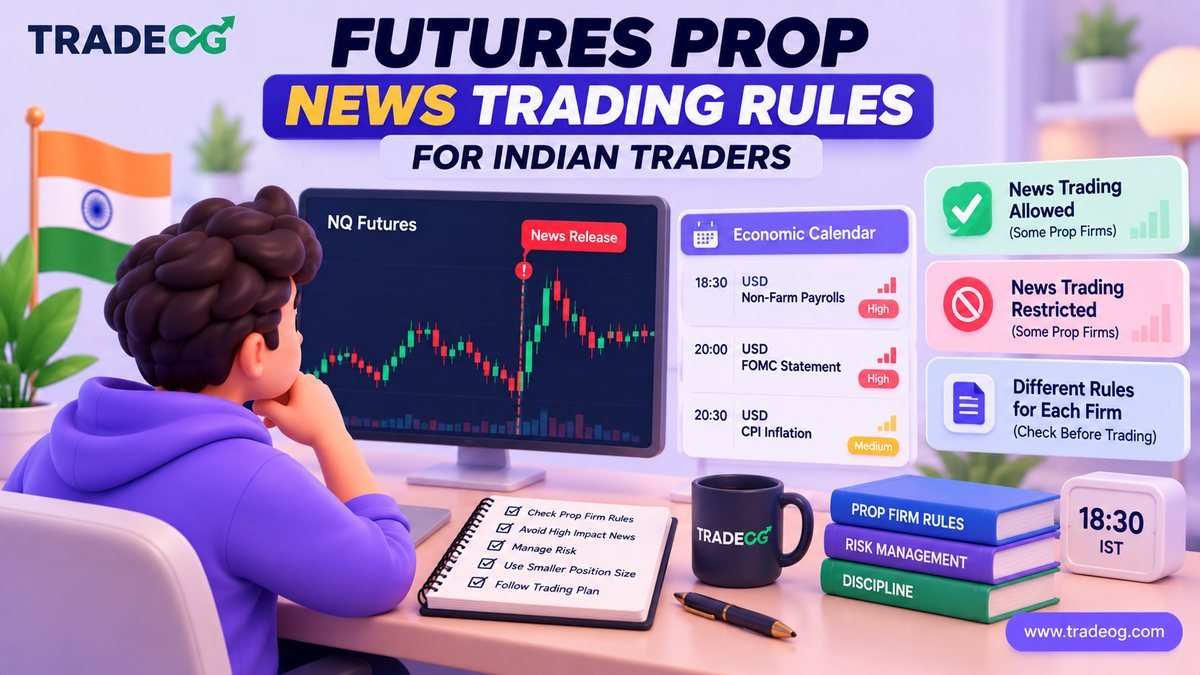
If you trade NQ, ES, GC, CL or other futures products from India through a prop firm, economic news can create some of the fastest price movements of the entire trading session. A CPI number, FOMC decision, employment report or inventory release can move a futures contract sharply within seconds.
The important part is that there is no single universal futures prop firm news trading rule. One firm may allow news trading, another may restrict specific releases, and another may impose different rules depending on whether you are in an evaluation, simulated funded account or live account.
For Indian traders, the practical challenge is even bigger because U.S. economic releases happen according to U.S. time zones while you are planning trades in IST. You therefore need to understand both the market risk and the exact rulebook of the prop firm you are using. For a practical IST session reference, see our guide to CME futures prop trading time in India.
What Is News Trading in Futures?
News trading means opening, closing or managing a futures position around a scheduled economic or market-moving announcement. Common examples include:
- U.S. Non-Farm Payrolls (NFP)
- Consumer Price Index (CPI)
- FOMC interest-rate decisions and statements
- Unemployment data
- EIA crude oil inventories
- Major agricultural reports
- Other high-impact economic releases listed by a prop firm
These events can create rapid changes in price, liquidity and execution quality. Topstep, for example, specifically notes that economic releases can produce extreme volatility and that slippage is common during such events. Topstep Economic Releases
Why Prop Firms Have Different News Trading Rules
A common mistake is assuming that “news trading is allowed” or “news trading is banned” everywhere. In reality, the policy can be very specific.
For example, Topstep currently says traders do not have to flatten positions during economic releases in its SIM or Funded Accounts, although it recommends caution. It also states that purposely trading maximum position size directly into a scheduled major news event is prohibited. Topstep Economic Releases Topstep Prohibited Trading Strategies
MyFunded Futures takes a different approach for certain account stages. Its current News Trading Policy prohibits strategies designed to exploit immediate news bursts, including straddles and strangles, and requires certain accounts to have no positions or orders around Tier 1 releases. MyFunded Futures News Trading Policy
Take Profit Trader also publishes a different structure: its current guidance says news trading is unrestricted during evaluation, while funded PRO and PRO+ accounts have restrictions around specified major events. Take Profit Trader News Guide
The lesson: never transfer one prop firm’s news rules to another prop firm.
Futures Prop News Trading Rules: What Indian Traders Need to Check
Before trading an economic release, check these seven things in your firm’s current rulebook:
- Is news trading allowed? Check whether the rule applies to evaluation, funded, live or all stages.
- Which news events are restricted? CPI, NFP and FOMC are common examples, but the exact list varies.
- What is the restricted time window? Some firms use a one-minute window; others use two minutes or another period.
- Are pending orders included? A rule may prohibit both open positions and resting orders.
- Are there position-size restrictions? Some firms can temporarily reduce contract limits around extreme volatility.
- How are slippage and fills handled? A stop can fill materially away from its intended price during a fast move.
- Does the rule apply to your specific product? NQ, ES, GC, CL and agricultural contracts can have different news drivers.
Example: How a News Restriction Can Work
Imagine a prop firm publishes a rule saying that traders must have no open positions or orders two minutes before and two minutes after a Tier 1 release.
If CPI is scheduled for 8:30 a.m. New York time, a trader following a two-minute rule would need to be flat by 8:28 and could only re-enter after 8:32, subject to the firm’s exact terms.
This is not a universal rule. It is an example of how a firm-specific restriction can work. MyFunded Futures currently uses a two-minute-before and two-minute-after window for certain Tier 1 news restrictions. MyFunded Futures News Trading Policy
What About Indian Time (IST)?
This is where many Indian traders make mistakes. Prop firms normally publish release times using U.S. time zones, while your trading routine is based on IST.
The IST conversion can also change when the United States moves between daylight saving time and standard time. Therefore, do not memorize a fixed “CPI is always at X IST” rule for the entire year.
Instead, use this workflow:
- Open the official economic calendar.
- Confirm the release date and U.S. time.
- Convert it to IST for your trading plan.
- Check the prop firm’s own news calendar or rule page.
- Confirm the restricted window immediately before the session.
For futures traders, the product and session also matter. Topstep’s current economic-release guide, for example, lists unemployment data, FOMC, EIA inventories and agricultural reports with affected futures products and release times. Topstep Economic Releases
NFP News Trading Rules for Futures Prop Traders
Non-Farm Payrolls is one of the most watched U.S. economic releases because it can produce a rapid move in equity-index futures and other markets.
For an Indian trader, the important question is not simply “Can I trade NFP?” The correct questions are:
- Does my prop firm permit NFP trading?
- Does the restriction apply only after funding?
- Can I hold an existing position through the release?
- Do pending limit or stop orders need to be cancelled?
- Is maximum position size restricted?
- What happens if slippage pushes my loss through a drawdown threshold?
Topstep’s current economic-release policy does not require traders to flatten for releases, but it warns about slippage and says results remain the trader’s responsibility. Its prohibited-strategy rules separately prohibit intentionally trading maximum position size directly into a scheduled major news event. Topstep Economic Releases Topstep Prohibited Trading Strategies
CPI Trading in Futures Prop Accounts
CPI can be particularly important for index futures and metals because inflation data can influence expectations about monetary policy.
Some prop firms treat CPI as a Tier 1 event. MyFunded Futures currently lists CPI among its Tier 1 news events and applies specific restrictions to certain funded account types. MyFunded Futures News Trading Policy
Topstep has also introduced temporary risk adjustments around CPI. Its current policy describes restrictions on new opening transactions for certain equity-index products around the release, while specific limits can vary by contract and account size. Topstep Risk Adjustments
This illustrates why Indian traders should not rely on an old screenshot, YouTube video or Telegram message. A firm’s news policy can change.
FOMC News Trading Rules
FOMC decisions can produce very fast moves in NQ, ES, bonds and other futures. The statement, rate decision and press conference can each affect volatility.
Topstep’s economic-release documentation currently identifies the FOMC statement as a major release affecting all listed products. Topstep Economic Releases
If your firm restricts FOMC trading, check whether the rule covers:
- the statement only,
- the press conference,
- a defined number of minutes around the event,
- pending orders,
- new entries but not existing positions, or
- all trading activity.
News Trading vs. News Gambling
There is an important difference between having a documented news strategy and taking an oversized bet because a release is expected to move the market.
A controlled plan might define:
- maximum dollar risk per trade,
- maximum number of contracts,
- maximum daily loss,
- acceptable entry conditions,
- stop placement,
- what news events are avoided, and
- when trading stops for the day.
By contrast, entering a maximum-size position seconds before a major release because “the market will definitely go up” creates a very different risk profile.
Topstep’s current Responsible Trading guidance specifically identifies max-position behavior, trading without stops, full-port trading, FOMO, revenge trading and disrespecting daily limits as behaviors that can trigger additional risk-management intervention. Topstep Responsible Trading
Why Slippage Is the Biggest News-Trading Risk
Suppose you trade NQ and place a stop expecting a $150 loss. During a high-impact release, the market can move through the stop before sufficient liquidity is available at your requested price.
Your actual fill can therefore be worse than the stop price. If the resulting loss is large enough, it can interact with your firm’s Daily Loss Limit or Maximum Loss Limit.
Topstep explicitly states that slippage is common during economic releases and that it does not adjust accounts for losses caused by normal market slippage. Topstep Economic Releases
For this reason, “I had a stop” does not automatically mean “my risk was fixed.” During fast news, execution risk matters.
Pending Orders Are Important Too
Indian traders sometimes focus only on open positions and forget about resting orders.
A prop firm’s news policy may define a restricted period in which no positions or orders can remain active. MyFunded Futures, for example, explicitly includes limit orders in its Tier 1 restriction for the applicable accounts. MyFunded Futures News Trading Policy
If your strategy places Buy Stop and Sell Stop orders around a scheduled release, read the firm’s policy carefully. A straddle-style setup may be prohibited even if only one side eventually fills.
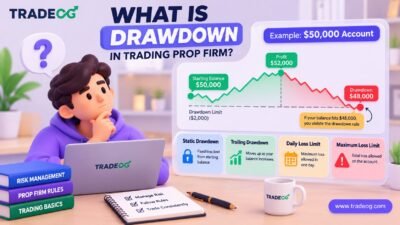
Does News Trading Affect Drawdown?
News trading does not create a special universal drawdown calculation. Instead, the firm’s normal drawdown methodology generally continues to apply while the market is moving.
That can include:
- realized P&L,
- unrealized P&L,
- Daily Loss Limit,
- Maximum Loss Limit,
- trailing drawdown,
- position-size limits, and
- firm-specific liquidation rules.
For example, Topstep states that its MLL is monitored in real time using realized and unrealized P&L, while its Daily Loss Limit can flatten positions and cancel pending orders when the limit is reached. Topstep Daily Loss Limit
That means a trader can be within the news policy and still breach the account’s risk limits because of a fast adverse move. For more detail on how a futures prop firm Maximum Loss Limit can work, see How Futures Prop Firm Maximum Loss Limit Is Calculated.
Which Futures Are Most Relevant During News?
The answer depends on the release.
| News Event | Commonly Watched Futures | Main Risk |
|---|---|---|
| NFP / Employment | NQ, ES, YM, GC and FX futures | Fast volatility and slippage |
| CPI | NQ, ES, GC, interest-rate futures | Rapid repricing of rate expectations |
| FOMC | NQ, ES, ZN, ZB, GC | Large moves around policy decisions |
| EIA inventories | CL, QM, MCL | Oil-specific volatility |
| Agricultural reports | ZC, ZS, ZW and related contracts | Sharp contract-specific moves |
Always verify the exact products affected by the release and the prop firm’s current rules. Topstep’s economic-release page is one example of a firm-specific product mapping. Topstep Economic Releases
A Practical News Trading Plan for Indian Traders
If your prop firm allows the type of news trading you want to perform, a simple process can reduce avoidable mistakes:
- Check the calendar before the session. Identify CPI, NFP, FOMC and product-specific releases.
- Convert the event time to IST. Recheck daylight-saving changes rather than relying on memory.
- Read your firm’s news policy. Do not use another firm’s rules as a substitute.
- Mark a no-trade window. Even when news is allowed, decide in advance whether you will avoid the initial spike.
- Reduce position size. Smaller exposure gives the trade more room for unexpected execution.
- Know your drawdown buffer. Calculate how much room remains before the firm’s risk threshold.
- Check pending orders. Cancel them if the firm’s rules require a flat order book.
- Do not revenge trade. If the first move goes against you, do not increase size to recover the loss.
Can Indian Traders Trade NQ During U.S. News?
Potentially, but the answer depends on the prop firm and account stage.
NQ is one of the most actively watched U.S. equity-index futures contracts around major macro releases. Some firms permit news trading while others restrict specific events or specific account types. The same trader could therefore be allowed to trade NQ through CPI at one firm and prohibited from doing so at another.
For Indian traders, the safest operational approach is to treat the firm’s current written policy as the source of truth and build the IST schedule around it.
Common Mistakes Indian Futures Prop Traders Make
- Using old rules: prop firms update policies and account structures.
- Confusing evaluation and funded rules: the same firm can have different restrictions by stage.
- Ignoring pending orders: a restriction may cover orders as well as positions.
- Using U.S. time incorrectly: daylight saving changes can shift IST timing.
- Trading maximum size into news: a large position can turn normal volatility into a drawdown event.
- Assuming a stop guarantees the loss: slippage can make the realized loss larger.
- Following another trader’s rule sheet: only the current official policy for your account should control your decision.
Futures Prop News Trading Checklist
Before pressing Buy or Sell around major news, ask:
- What exact event is scheduled?
- What time is it in IST?
- Does my prop firm restrict this event?
- Does the restriction apply to my account stage?
- Are existing positions allowed?
- Are pending orders allowed?
- Is there a restricted window before and after the release?
- What is my current drawdown buffer?
- What is my maximum dollar risk?
- Could slippage make the trade exceed my planned risk?
Final Takeaway
Futures prop news trading rules for Indian traders are firm-specific, account-specific and subject to change. There is no universal rule saying that Indian traders can or cannot trade NFP, CPI or FOMC.
Current examples show why checking the exact rulebook matters. Topstep currently allows traders to remain in positions through economic releases but warns about slippage and prohibits intentionally trading maximum position size directly into scheduled major news. MyFunded Futures applies specific Tier 1 restrictions to certain account stages, while Take Profit Trader publishes its own event restrictions for funded accounts. Topstep Economic Releases Topstep Prohibited Trading Strategies MyFunded Futures News Trading Policy Take Profit Trader News Guide
If you trade from India, combine the firm’s current written rules with an IST economic calendar, a defined risk limit and a clear decision about whether you will trade or avoid the initial news spike. If NQ is your main instrument, our guide to NQ futures prop trading risk per trade covers contract value, stop sizing and drawdown management. The goal is not simply to catch a large move; it is to make sure one fast market event does not destroy the account’s drawdown buffer.
Official Sources & Further Reading
- Topstep — Economic Releases
- Topstep — Prohibited Trading Strategies
- Topstep — Risk Adjustments: High Risk/High Volatility
- Topstep — Daily Loss Limit
- Topstep — Responsible Trading
- MyFunded Futures — News Trading Policy
- Take Profit Trader — How to Trade News in Futures
Risk disclosure: This article is for educational and informational purposes only. Prop firm rules, product availability, trading hours, news restrictions and account terms can change. Always verify the current official rules for your specific account before trading. Trading futures involves substantial risk, and simulated or funded-program results do not guarantee future performance.