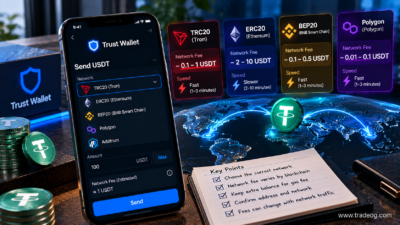

Sending USDT from Trust Wallet looks simple: choose USDT, paste an address, select a network and tap Send. The dangerous part is that USDT can exist on multiple blockchain networks. If you select the wrong network, the transaction can be confirmed on-chain while the recipient still cannot access or credit the funds.
For example, sending USDT using TRON to a destination that only expects Ethereum ERC20 USDT is not the same as sending a normal bank transfer to the wrong account. Blockchain transactions are generally irreversible, and recovery depends heavily on who controls the destination address and whether the receiving platform supports recovery for that specific network.
This guide explains what actually happens after a wrong-network USDT transfer from Trust Wallet, when funds may still be recoverable, when they may be effectively lost, what you should do immediately, and how Indian traders can prevent the problem when moving prop-firm payouts or converting USDT to INR.
What Happens When You Send USDT on the Wrong Network?
The first thing to understand is that the blockchain does not necessarily know that you made a mistake.
If you submit a valid transaction on a supported blockchain, that network can process and confirm it even when the receiving service was expecting a different network.
For example:
- You have USDT on TRON.
- The destination platform gives you an ERC20 deposit route.
- You accidentally select the TRON network in Trust Wallet.
- The transaction is confirmed on TRON.
- The destination platform is monitoring the Ethereum network for that deposit.
- Your expected USDT does not appear in the platform balance.
The transaction can therefore be successful on the blockchain but unsuccessful for your intended deposit.
Trust Wallet’s current sending guidance specifically tells users to check the recipient address, coin, amount and network before confirming. It also warns that sending crypto on the wrong network can result in permanent loss. Trust Wallet’s official sending and receiving guide explains these precautions.
Why USDT Creates This Confusion
USDT is a stablecoin issued across multiple blockchain networks. Tether describes USD₮ as blockchain-agnostic and has issued it on networks including Ethereum and TRON. citeturn0search2turn0search24
That means two wallets can both display:
USDT
while actually holding different network versions of the asset.
For a trader, the important information is therefore not just:
“I am sending USDT.”
It is:
“I am sending this USDT on this specific blockchain to this specific network-compatible destination.”
TRC20 vs ERC20: A Simple Example
Suppose you want to send 1,000 USDT from Trust Wallet.
Your destination platform shows:
USDT — ERC20
You open Trust Wallet and accidentally choose:
USDT — TRC20
You then paste the destination address and confirm.
The transaction may successfully appear on the TRON blockchain. However, the receiving platform may only credit deposits that arrive through its Ethereum ERC20 deposit route.
This is why the statement “the address is the same” or “both are USDT” is not enough to establish compatibility.
Can a Wrong-Network Transaction Be Reversed?
Usually, you cannot simply press an Undo button.
Trust Wallet states that it cannot cancel or modify blockchain transactions after they are submitted. The wallet also explains that transactions are processed by the applicable blockchain network rather than by a blockchain operated by Trust Wallet. Trust Wallet’s Terms of Service describe these limitations.
Whether your funds can be recovered depends on the exact circumstances.
There are three broad situations:
| Situation | Potential Outcome |
|---|---|
| Wrong network, but you control the destination wallet | Recovery may be possible by accessing the relevant network/asset in a compatible wallet |
| Wrong network sent to an exchange or platform you do not control | Recovery depends on that platform’s policies and technical ability |
| Wrong network sent to an incompatible or inaccessible destination | Recovery may be extremely difficult or impossible |
So “wrong network” does not always mean “money is definitely gone.” But it should always be treated as a serious recovery problem.
Scenario 1: You Sent USDT to Your Own Wallet on the Wrong Network
This is often the most recoverable scenario.
Imagine you intended to move ERC20 USDT between wallets you personally control, but the funds were sent using another supported network and the receiving wallet interface is not currently displaying the asset.
If the private keys control the relevant address and the wallet supports the corresponding blockchain, the funds may still exist at an address you control. The problem can be that the wallet interface is showing the wrong network or asset.
In this situation, do not immediately assume the funds have disappeared.
First identify:
- which blockchain was actually used;
- the transaction hash;
- the destination address;
- the token contract or asset;
- whether you control the private keys for that address;
- whether the wallet supports that network.
Do not enter your recovery phrase into an unfamiliar website claiming to “recover” the funds.
Scenario 2: You Sent USDT to an Exchange on the Wrong Network
This situation is more complicated.
You do not control the exchange’s private keys. The exchange controls the deposit infrastructure.
Suppose an exchange gives you an ERC20 USDT deposit address, but you send USDT on TRON.
The address may appear visually similar to an Ethereum address in some situations, but that does not mean the exchange will automatically credit the deposit.
Contact the exchange’s official support or deposit-recovery team.
Provide:
- transaction hash;
- asset name;
- network used;
- amount;
- destination address;
- date and time;
- your exchange account ID or deposit reference if applicable.
Do not send another transaction to “fix” the first one unless the official platform specifically instructs you to do so.
Scenario 3: The Address Is Yours, but the Network Is Wrong
This is different from sending to a platform-owned deposit address.
If you control the destination wallet’s private keys, recovery may be technically possible depending on the blockchain and wallet architecture.
For example, an address may be usable across compatible address formats or networks, but the token must still be accessed through the correct blockchain and asset configuration.
The important distinction is:
Same address format does not automatically mean same asset or same network.
Do not experiment with private keys or seed phrases unless you fully understand what you are doing. If the amount is significant, use the official wallet documentation or a qualified blockchain recovery professional.
What Should You Do Immediately After a Wrong-Network Transfer?
If you have just made the mistake, stop sending funds.
Then follow this sequence:
- Do not panic.
- Do not send another transaction.
- Copy and save the transaction hash.
- Identify the blockchain network actually used.
- Confirm the destination address.
- Check the transaction on the relevant blockchain explorer.
- Determine whether the destination wallet is controlled by you or a platform.
- If it is a platform, contact only official support.
- If it is your own wallet, determine whether that wallet supports the network and asset.
- Keep screenshots and transaction records.
Trust Wallet’s transaction-status guidance explains that blockchain transactions can be pending, failed or confirmed and that users can track transaction progress through blockchain explorers. Trust Wallet’s transaction-status guide provides more detail.
Step 1: Find the Transaction Hash
The transaction hash is the most useful starting point after a transfer mistake.
Open the transaction history in Trust Wallet and locate the transfer.
Look for:
- transaction ID;
- transaction hash;
- view on explorer;
- blockchain explorer link.
Copy the hash and keep it somewhere safe.
The hash allows you to determine whether the blockchain actually processed the transaction.
Step 2: Identify the Actual Network Used
Do not rely on memory.
Check the transaction details.
You may discover that you actually sent:
- TRON/TRC20;
- Ethereum/ERC20;
- BNB Smart Chain/BEP20;
- Polygon;
- Arbitrum;
- another supported USDT network.
USDT exists across multiple blockchain networks, and Tether’s current materials list a broad range of supported chains. citeturn0search24
This is why the article title says “wrong network” rather than simply “wrong address.” The network itself is part of the transaction destination.
Step 3: Verify the Destination Address
Compare the address in your transaction with the address provided by the recipient.
Check the first and last characters.
If the address was copied from an exchange deposit page, save a screenshot of that page if available.
If the address belongs to your own Trust Wallet, verify that you still control the wallet.
Step 4: Check the Blockchain Explorer
Open the explorer for the blockchain that was actually used.
Verify:
- transaction status;
- sender;
- recipient;
- token;
- amount;
- timestamp;
- block confirmation.
If the transaction is confirmed, the blockchain itself has generally completed its part of the transfer. The problem is then usually on the receiving side or with the network/asset configuration.
What If the Transaction Is Still Pending?
A pending transaction is different from a confirmed wrong-network transaction.
If it is still pending, check the transaction details and network status.
Do not pay a stranger who claims they can “speed up” or “unlock” the USDT.
Trust Wallet explains that blockchain conditions can affect transaction confirmation and that it cannot guarantee confirmation or execution of a submitted transaction. See Trust Wallet’s terms.
What If the Transaction Failed?
A failed transaction can be less serious than a confirmed wrong-network transfer because the token transfer may not have completed.
However, network fees can still be charged for failed blockchain transactions depending on the network and transaction type.
Check the explorer status before attempting another transfer.
What If the Transaction Is Confirmed but the USDT Is Missing?
This is where the distinction between blockchain confirmation and platform crediting becomes important.
A confirmed transaction means the network recorded the transaction. It does not necessarily mean an exchange or payment platform will credit the balance.
If the destination is an exchange:
- Check the exchange’s deposit requirements.
- Confirm the network you used.
- Compare it with the network the deposit page supported.
- Check whether the platform has a wrong-network recovery procedure.
- Contact official support with the transaction hash.
Can Trust Wallet Recover Wrong-Network USDT?
Trust Wallet is a self-custody wallet and does not control the underlying blockchain network. Its terms explicitly state that it cannot cancel or modify blockchain transactions. citeturn0search6
Therefore, contacting Trust Wallet does not automatically mean the wallet company can reverse a confirmed transaction.
If you control the destination wallet, the issue may instead be about accessing the correct network or token through a compatible wallet interface.
If you sent the funds to a third-party platform, that platform may be the only party capable of investigating or recovering the deposit.
Wrong Network vs Wrong Address
These two problems are related but different.
| Problem | Meaning | Typical Recovery Question |
|---|---|---|
| Wrong network | Correct or intended destination, but the transaction used a different blockchain | Does the recipient control or support the network actually used? |
| Wrong address | Funds were sent to an unintended blockchain address | Who controls that address? |
| Wrong asset | A different token was sent instead of USDT | Does the recipient support that token and network? |
The recovery prospects are different for each case.
Why a Test Transfer Can Save a Large USDT Payout
Suppose you receive a 5,000 USDT prop-firm payout.
You could immediately send all 5,000 USDT to a new exchange deposit address.
Or, if the platform allows it, you could first send a small amount and confirm that the deposit arrives correctly.
The second approach adds an extra transaction cost, but it can substantially reduce the operational risk of discovering a network mismatch after the entire balance has been sent.
For a new wallet or exchange, a test transfer is a sensible risk-control measure.
How Indian Traders Can Avoid Wrong-Network USDT Losses
Indian traders often move USDT through a chain such as:
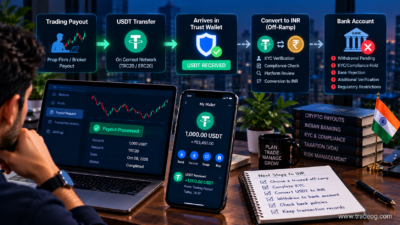
Prop Firm → Trust Wallet → Crypto Platform → USDT/INR → Indian Bank Account
Each step creates another opportunity for a network mismatch.
Before every transfer, confirm:
- USDT asset;
- network;
- destination address;
- deposit network supported by the destination;
- withdrawal fee;
- minimum deposit;
- memo/tag requirements;
- transaction limit.
For the previous step in this TradeOG series, see How to Move USDT From a Prop Firm to Trust Wallet.
Wrong-Network Example: Prop Firm to Trust Wallet
Imagine your prop firm offers:
- USDT-TRC20;
- USDT-ERC20.
Your Trust Wallet setup is prepared to receive USDT on TRON.
You should:
- Open Trust Wallet.
- Select the matching USDT network.
- Tap Receive.
- Confirm the network displayed.
- Copy the receiving address.
- Return to the prop firm’s payout page.
- Select exactly the same network.
- Paste and verify the address.
- Review the fee.
- Submit the withdrawal.
Do not select ERC20 just because its address looks familiar, and do not select TRC20 simply because its withdrawal fee is lower.
Wrong-Network Example: Trust Wallet to INR Platform
Suppose your INR conversion platform supports USDT-ERC20 but not USDT-TRC20.
Your Trust Wallet contains USDT on TRON.
The correct approach is not to paste the ERC20 deposit address into a TRC20 withdrawal and hope the platform will find it.
Instead, use a conversion route that explicitly supports the network you hold, or use a properly supported network conversion route before making the deposit.
For the full INR conversion workflow, read Trust Wallet to INR: How Indian Traders Can Convert USDT to Rupees.
Never Share Your Recovery Phrase to Fix a Wrong Transfer
This is one of the most important security rules.
If someone contacts you and says:
- “Give me your seed phrase and I will recover the USDT.”
- “Connect your wallet to this recovery website.”
- “Send another USDT payment to unlock the lost funds.”
- “Pay a recovery fee to our wallet.”
stop.
Trust Wallet states that the Secret Recovery Phrase is critical to wallet control and should not be shared. Its security guidance says the phrase is the master key to the wallet. Trust Wallet’s official backup and recovery guide explains this security principle.
A legitimate support process should not require you to disclose your recovery phrase.
Can a Wrong-Network Transfer Be Recovered by the Exchange?
Sometimes, but never assume it.
An exchange may have technical access to multiple networks and may be able to locate a deposit sent to an address it controls. However, recovery can depend on:
- the network;
- the token contract;
- whether the exchange controls the destination address;
- the exchange’s internal infrastructure;
- the amount;
- the platform’s recovery policy;
- technical and compliance requirements.
Some platforms may charge a recovery fee or decline certain recovery requests entirely.
Use only the exchange’s official support channel.
What Information Should You Give Support?
If an exchange or payment platform is investigating the transaction, prepare a clean transaction package.
| Information | Why It Helps |
|---|---|
| Transaction hash | Identifies the blockchain transaction |
| Network | Shows which blockchain processed the transfer |
| Token | Identifies the asset sent |
| Amount | Helps locate the transaction |
| Destination address | Identifies the receiving address |
| Date/time | Narrows the transaction record |
| Account/deposit reference | Connects the transaction to your platform account |
Do not send your private key or recovery phrase.
Common Myths About Wrong-Network USDT
“If the address starts with 0x, every USDT network will work.”
False. Address appearance alone does not establish that the receiving platform supports the specific network used for the transfer.
“Trust Wallet can reverse the transaction.”
Generally no. Trust Wallet states that it cannot cancel or modify blockchain transactions after submission.
“A confirmed transaction means the exchange must credit it.”
Not necessarily. The blockchain can confirm a transaction while the exchange’s deposit system does not support or recognise that network route.
“Sending another transaction will recover the first one.”
No. A second transaction does not automatically reverse the first.
“Support needs my seed phrase.”
No legitimate recovery process should require you to disclose your Secret Recovery Phrase.
Wrong-Network USDT Prevention Checklist
- Check the exact USDT network.
- Open the destination’s current deposit page.
- Confirm that the destination supports that network.
- Copy the address directly.
- Check the first and last characters.
- Check any memo/tag requirement.
- Review the amount.
- Review the withdrawal fee.
- Consider a small test transfer.
- Save the transaction hash.
- Never share your recovery phrase.
TRC20 vs ERC20: Which Mistake Is More Common?
There is no universal statistic showing that one network is responsible for more mistakes. The important lesson is that users frequently focus on the token name and overlook the network.
For example, a trader sees “USDT” and assumes the receiving address will accept any USDT. That assumption is dangerous.
TRC20 and ERC20 are different network representations. Tether’s documentation confirms that USDT is issued across multiple blockchains, while Trust Wallet’s guidance specifically tells users to verify the network before sending. citeturn0search2turn0search13
Frequently Asked Questions
What happens if I send USDT to the wrong network from Trust Wallet?
The transaction can still be confirmed on the blockchain, but the recipient may not recognise or credit the funds. Recovery depends on whether you control the destination and whether the receiving platform supports recovery for that network.
Can I recover USDT sent on the wrong network?
Sometimes. If you control the destination wallet and it supports the relevant network, recovery may be technically possible. If the destination belongs to an exchange, recovery depends on that exchange’s technical capabilities and policy.
Can Trust Wallet reverse a wrong-network transfer?
No. Trust Wallet states that it cannot cancel or modify blockchain transactions after submission.
What should I do first?
Stop sending funds, save the transaction hash, identify the actual network and destination address, then contact the official receiving platform if it is not your own wallet.
Is a confirmed transaction always lost if the network was wrong?
No. A confirmed wrong-network transfer can sometimes be recovered, particularly when you control the destination wallet. But recovery is not guaranteed.
Should I send another transaction to fix it?
No. Do not send additional funds unless the official receiving platform gives you a specific, verified recovery instruction.
Can an exchange recover USDT sent on the wrong network?
Possibly, but it depends on the exchange, network, asset and destination infrastructure. Some platforms may charge a recovery fee or may not support recovery.
How can I prevent this problem?
Match the asset, network and receiving address before every transaction. For a new destination, use a small test transfer when practical.
Final Takeaway
A wrong-network USDT transfer from Trust Wallet is serious, but “wrong network” does not automatically mean the funds are permanently lost.
The recovery question is ultimately about control and compatibility:
Who controls the destination address, which blockchain processed the transaction, and does the receiving system support that network?
If you make the mistake, do not panic and do not make the situation worse by sending more funds. Save the transaction hash, identify the network, verify the destination and contact the legitimate receiving platform if necessary.
For future transfers, use the simplest rule:
USDT + correct network + correct address + correct destination support = safer transfer.
Saving a few USDT on fees is never worth risking the entire transaction through a network mismatch.
Disclaimer: TradeOG provides educational and informational content only. Nothing in this article should be treated as financial, investment, legal, tax, banking, regulatory or professional advice. Blockchain transactions can be irreversible, recovery is not guaranteed, and network support varies between wallets and platforms. Always verify the asset, network, destination address and current provider instructions before sending funds. For significant losses or recovery situations, use official platform support and seek qualified professional assistance where appropriate.