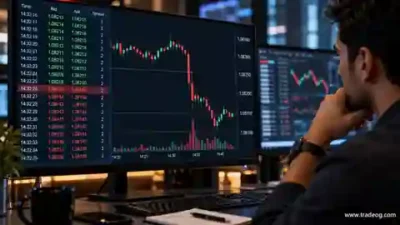

Short-term traders often believe that watching every tick will make them faster, more informed and better at catching entries. In reality, constantly monitoring every small price change can make trading more difficult. The more closely you watch every fluctuation, the easier it becomes to confuse normal market noise with a meaningful signal.
This problem is especially common in forex, gold and other highly liquid markets where prices can change dozens of times within seconds. A trader may enter because price moves a few points, exit because of a tiny pullback, re-enter when momentum returns and eventually end the session with several unnecessary trades.
The issue is not that tick data is useless. The problem is that human decision-making is usually not improved by reacting to every tick. A structured trading plan needs meaningful information, not constant stimulation.
What Does Watching Every Tick Mean?
Watching every tick means monitoring extremely small price changes continuously instead of evaluating price at a predefined timeframe or around specific trading conditions.
For example, a trader using a 5-minute strategy might have a clear setup based on candle close, market structure and a defined risk level. But while waiting for the candle to close, the trader watches every small movement. Price moves slightly against the position, and the trader becomes uncomfortable. A few seconds later price moves back, creating confidence again.
The strategy has not changed. Only the trader’s emotional interpretation of the price has changed.
Why Every Tick Contains So Much Market Noise
Financial prices do not move in a perfectly smooth line. Short-term fluctuations can result from bid-ask dynamics, order flow, liquidity changes, execution, short-term positioning and new orders entering the market.
Many of these movements have little relevance to the broader setup a trader is trying to trade.
On a very short observation window, a market can look chaotic even when the underlying trend is clear. This creates a classic problem: the shorter the observation window, the more random movement can appear to look like information.
A trader who focuses on every tick may therefore react to information that has no predictive value for the original trading timeframe.
Every Tick Can Make a Good Setup Look Bad
Suppose a trader enters EUR/USD based on a 15-minute breakout. The plan allows a normal pullback after entry before continuation.
On the 15-minute chart, the trade still looks valid. But on a tick-by-tick view, the trader sees dozens of small moves against the position. Each one can feel like confirmation that the breakout is failing.
The trader may close the position early. Five minutes later, price resumes the expected move.
This creates a particularly frustrating outcome: the strategy may have been correct, but the trader’s constant monitoring prevented the strategy from being executed properly.
Watching Every Tick Encourages Overtrading
One of the biggest dangers is that constant observation creates more perceived opportunities.
If you watch a chart for three hours, you may see hundreds of small price movements. If your trading rules are not extremely strict, some of those movements will start to look like entries.
This can lead to:
- taking trades outside the original setup;
- entering because price suddenly moves quickly;
- re-entering immediately after a stop-out;
- taking profit too early;
- moving a stop loss unnecessarily;
- increasing position size after a loss; and
- trading simply because the market is moving.
More screen time does not automatically create more high-quality opportunities. Sometimes it simply creates more decisions.
Why Tick-by-Tick Monitoring Increases FOMO
Fear of missing out, or FOMO, becomes easier to trigger when a trader sees a market move in real time.
A candle that looked ordinary a few seconds earlier can suddenly accelerate. The trader sees price moving without them and feels pressure to enter immediately.
The resulting trade is often based on the fear of missing the move rather than a predefined setup.
This is particularly dangerous after a large breakout candle. By the time the trader reacts to the visible movement, the original risk-to-reward opportunity may already have changed.
Small Pullbacks Can Trigger Premature Exits
Every market experiences pullbacks. A healthy trend can move higher while repeatedly making small moves lower. A bearish trend can do the opposite.
When a trader watches every tick, these ordinary pullbacks can feel much more significant than they actually are.
For example:
- A long trade is entered after a valid bullish setup.
- Price moves in profit.
- A small pullback appears.
- The trader sees several consecutive lower ticks.
- Fear increases.
- The trader closes the position.
- Price resumes the original trend.
The problem was not necessarily the entry. The problem was using information from a much smaller timeframe to manage a trade designed around a larger timeframe.
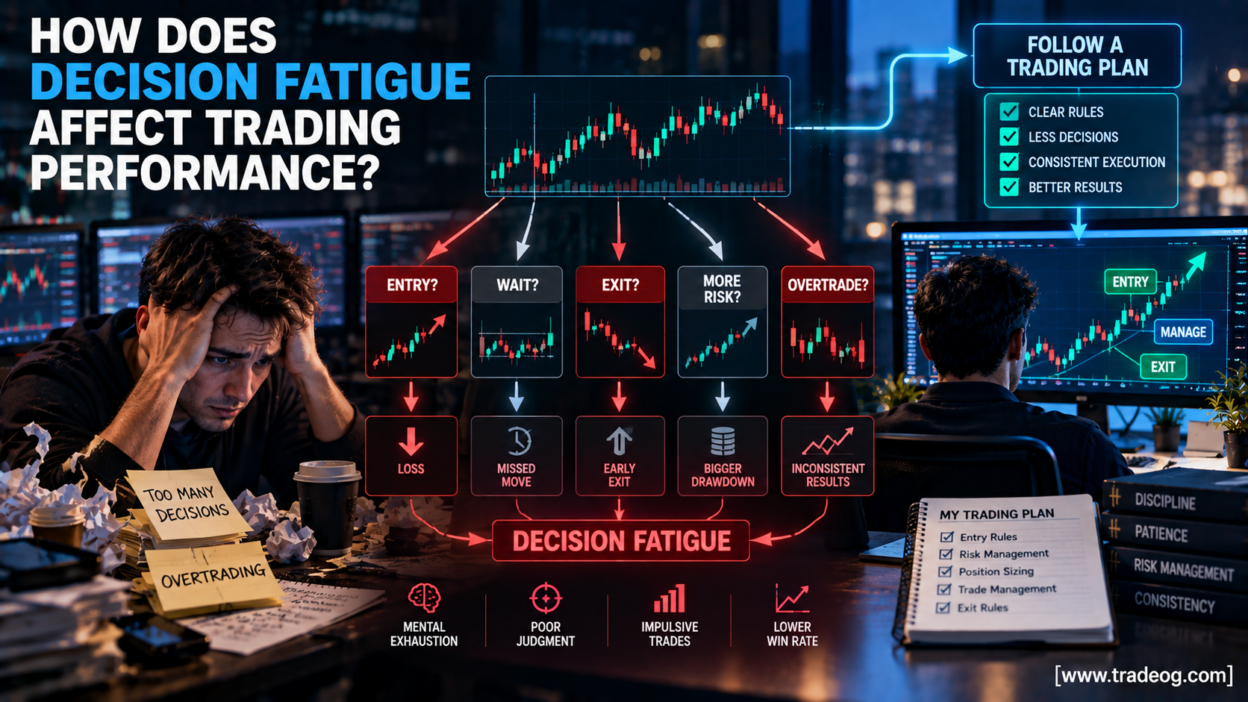
Tick Watching Can Create Decision Fatigue
Trading requires repeated decisions: enter, hold, exit, adjust risk or do nothing. Constantly watching every small movement increases the number of decisions your brain is asked to make.
Eventually, decision quality can deteriorate.
A trader may begin the session following the plan carefully but later start taking weaker setups, changing stops, chasing moves or exiting positions without a valid reason.
This is one reason why reducing unnecessary screen-based decisions can improve consistency.
Why “Doing Nothing” Becomes Difficult
Good trading often requires waiting.
But waiting is psychologically difficult when a chart is moving constantly. Every tick provides another opportunity to question the previous decision.
A trader may think:
- “Should I close now?”
- “Should I move my stop?”
- “Is this a reversal?”
- “Should I enter again?”
- “What if the breakout fails?”
When these questions are triggered by ordinary price fluctuations rather than a change in the trading plan, the trader can become their own source of noise.
The Difference Between Useful Monitoring and Overmonitoring
Monitoring a trade is not inherently bad. Professional execution still requires attention to risk, scheduled events and market conditions.
The difference is whether you are watching for predefined information or reacting to every movement.
| Useful Monitoring | Overmonitoring |
|---|---|
| Checking whether the setup remains valid | Reacting to every tick |
| Monitoring stop-loss and risk | Moving stops because of fear |
| Watching important economic events | Chasing sudden candles |
| Following the chosen timeframe | Constantly switching timeframes |
| Reviewing planned exit conditions | Taking profit because of a tiny pullback |
Use Your Trading Timeframe to Filter Noise
If your strategy is built around a 15-minute chart, the 15-minute structure should normally carry more weight than individual price fluctuations occurring inside one candle.
This does not mean lower-timeframe information should always be ignored. It means it should have a defined role.
For example, a trader might use:
- 1-hour chart: broader market direction;
- 15-minute chart: setup identification;
- 5-minute chart: entry refinement;
- tick movement: execution awareness only.
The exact combination depends on the strategy. The important principle is to decide the role of each timeframe before the trade rather than changing the interpretation after price starts moving.
Why Tick Data Is Different From a Trading Signal
Price movement is information, but not every piece of information is a trading signal.
A single price change tells you that the market traded at a different level. It does not automatically tell you that a trend has changed, liquidity has disappeared or a breakout is confirmed.
For a trading signal to have meaning, it normally needs context. That context might include market structure, volatility, support and resistance, volume or liquidity conditions, economic news and the rules of the strategy.
Without context, individual ticks are easy to overinterpret.
Scalpers Need Rules More Than Constant Reaction
Scalpers may legitimately use very short-term price information, but that does not mean successful scalping requires emotional reaction to every tick.
A disciplined scalper can have predefined conditions for:
- entry;
- maximum spread;
- stop-loss distance;
- take-profit;
- maximum number of trades;
- news restrictions;
- session timing; and
- daily loss limits.
The shorter the strategy, the more important execution discipline becomes. If your edge is small, unnecessary trades and execution costs can quickly reduce it.
This is also why traders should pay attention to slippage during volatile periods. See Why Does Slippage Increase When Market Volatility Is Extremely High?.
How Watching Every Tick Can Change Risk Management
Risk management should normally be defined before entering the position. Constant monitoring can cause traders to modify those rules emotionally.
Common examples include moving a stop farther away because the trader does not want to accept a loss, closing a trade too early because of a small pullback, or increasing size after a losing trade to recover quickly.
These decisions can turn a predefined risk model into an unpredictable one.
A better approach is to decide in advance what would invalidate the trade. If that condition has not occurred, normal price noise should not automatically force a decision.
Every Tick Can Make You Confuse Speed With Importance
A fast price movement feels important because it happens quickly. But speed alone does not determine whether the move is meaningful.
A sudden move can be a genuine breakout, a liquidity event, a news reaction or simply short-term volatility. The trader needs context before assigning meaning to it.
This distinction is especially important around major economic releases. Price can move rapidly in both directions before the market establishes a clearer direction.
How to Stop Reacting to Every Tick
You do not necessarily need to stop watching charts completely. Instead, create rules that reduce unnecessary decisions.
1. Define the timeframe before trading
Choose the timeframe that controls the setup and write it down. Do not let every small movement change the timeframe of your analysis.
2. Define the invalidation level
Know what price action would genuinely invalidate the trade. If that level has not been reached, avoid inventing new reasons to exit.
3. Use alerts
Instead of staring continuously at the chart, use price alerts around important levels. This lets you focus on the conditions that actually matter.
4. Limit the number of trades
A daily trade limit can prevent boredom and market noise from turning into unnecessary entries.
5. Record why you changed a trade
If you close early or move a stop, write down the reason. During review, you can identify whether the change was based on a valid rule or an emotional reaction.
6. Take breaks after a sequence of trades
After several consecutive decisions, step away from the screen. A short break can prevent one trade from influencing the next decision emotionally.
A Practical Example: 15-Minute Gold Trade
Imagine a trader has a bullish setup on XAU/USD using the 15-minute timeframe. The entry is triggered after a defined breakout, with a predetermined stop and target.
During the next few minutes, gold moves slightly lower. The trader watches every tick and sees repeated selling pressure. The temptation is to exit.
But if the 15-minute setup remains valid and the original invalidation level has not been reached, the trade has not necessarily failed.
If the trader had followed the original rules, the position would either reach the planned exit or invalidate according to the predefined conditions. Watching every tick creates an additional decision layer that was never part of the strategy.
Does Watching Every Tick Ever Help?
Yes. There are situations where very short-term monitoring can be useful, particularly for execution, spread observation, order placement and strategies specifically designed around microstructure.
However, useful tick-level monitoring is different from emotional reaction to every movement.
If the trading strategy genuinely depends on tick-level information, that information should be tested as part of the strategy. If it does not, constantly watching ticks may simply encourage discretionary decisions that were never validated.
Signs You Are Watching the Market Too Closely
- You close trades even though your setup is still valid.
- You move your stop loss repeatedly.
- You enter trades because of sudden price acceleration.
- You switch between timeframes constantly.
- You take more trades when the market becomes active.
- You feel anxious during normal pullbacks.
- You check the chart immediately after every small movement.
- Your results are worse when you spend more time watching the market.
- You cannot leave an open trade without checking it repeatedly.
If several of these behaviours sound familiar, the problem may not be your strategy. Your monitoring process may be interfering with your execution.
How Traders Can Build a Lower-Noise Trading Routine
A practical routine could look like this:
- Identify the higher-timeframe market context.
- Define the exact setup you are waiting for.
- Set entry, stop-loss and target conditions.
- Decide which timeframe controls the trade.
- Set alerts at important levels.
- Enter only when the predefined conditions are met.
- Avoid changing the plan because of ordinary intrabar movement.
- Record the trade and review it later rather than analysing every tick while emotionally involved.
This approach does not remove uncertainty from trading. It simply reduces the number of unnecessary decisions you make while uncertainty is unfolding.
Frequently Asked Questions
Is watching every tick bad for traders?
Not always, but it can be harmful when traders react emotionally to small price changes that are irrelevant to their strategy. Constant monitoring can increase overtrading, FOMO and premature exits.
Why does watching every tick cause overtrading?
Continuous observation creates a constant stream of perceived opportunities. Without strict rules, traders can begin treating ordinary price fluctuations as entry signals.
Should I stop watching my trade after entering?
Not necessarily. You should monitor risk and important conditions, but you do not need to react to every small movement. Alerts and predefined invalidation levels can reduce unnecessary intervention.
Is tick-by-tick trading the same as scalping?
No. Scalping is a trading style involving short holding periods. A scalper can still use a structured process and predefined rules rather than reacting emotionally to every tick.
What timeframe is best for avoiding market noise?
There is no universally best timeframe. The appropriate timeframe depends on the strategy, market and holding period. The key is to use a timeframe that provides enough context for the decisions your strategy requires.
Final Takeaway
Watching every tick does not necessarily give a short-term trader an information advantage. In many cases, it gives the trader more opportunities to second-guess a valid plan.
Market noise becomes especially dangerous when it changes behaviour: entering late, exiting early, moving stops, chasing breakouts or taking trades that were never part of the strategy.
The objective is not to react to every movement. The objective is to identify the price information that matters to your trading system and ignore the rest.
Less reaction does not mean less discipline. For many short-term traders, it means more discipline.