

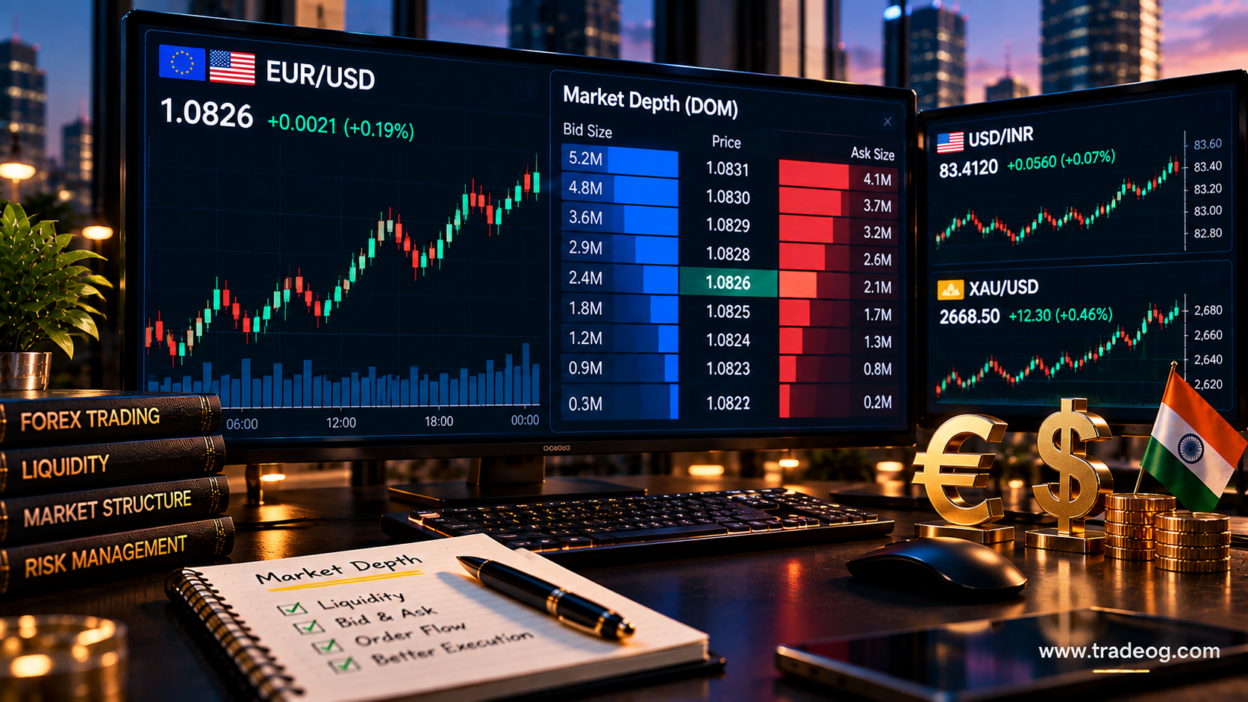
Quick answer: Forex market depth shows how much buying and selling interest is available around different price levels. It can help traders understand liquidity, potential price impact and execution conditions—but there is an important catch: spot forex does not have one centralized global order book. The “market depth” or Depth of Market (DOM) shown by a retail broker usually represents only that broker’s own liquidity sources, venue or internal book, not every forex order in the world.
That distinction matters. A thick-looking order book can be useful information, but it should not be treated as a perfect map of where the entire global FX market will buy or sell.
What Is Forex Market Depth?
Forex market depth refers to the amount of buy and sell interest available at different prices. In a traditional order-book market, traders can see bids below the current price and offers above it. The more executable liquidity available across nearby price levels, the deeper the market is.
For example, imagine an EUR/USD order book showing:
| Price | Bid Size | Ask Size |
|---|---|---|
| 1.0829 | — | 2.5M |
| 1.0828 | — | 3.1M |
| 1.0827 | — | 4.2M |
| 1.0826 | — | 6.8M |
| 1.0825 | — | — |
| 1.0824 | 6.1M | — |
| 1.0823 | 4.7M | — |
| 1.0822 | 3.5M | — |
The numbers suggest there is more displayed selling interest above the current price and meaningful buying interest below it. A trader can use that information to think about possible liquidity zones, execution quality and how much available liquidity sits near the market.
But the word displayed is crucial. What you see is not necessarily the complete global FX market.
Is There One Global Forex Order Book?
No. This is one of the most important concepts to understand before using market depth in forex.
Unlike a centralized stock or futures exchange, the global spot FX market is largely over the counter (OTC). Banks, dealers, electronic venues, liquidity providers and customers interact across a fragmented network of trading venues. The Bank for International Settlements describes FX as decentralized and fragmented, with trading occurring through multiple types of venues and with substantial internalization by dealers.
Some parts of the FX ecosystem do have central limit order books. For example, exchange-traded currency futures have a centralized matching environment. Inter-dealer FX venues can also operate central limit order books. But those books represent liquidity on those specific venues—not every order across the global FX market.
This is why a retail trader should never assume that a broker’s DOM is equivalent to a global forex order book.
How Does a Forex Order Book Work?
A conventional order book is built around two sides:
- Bid: prices where participants are willing to buy.
- Ask: prices where participants are willing to sell.
- Bid size: quantity available on the buy side at a given level.
- Ask size: quantity available on the sell side at a given level.
The closest bid and ask form the visible top of the book. The difference between them is the bid-ask spread.
As you move away from the current price, you see additional levels. This creates the “depth” of the book.
Top of Book vs Market Depth
Top of book normally refers to the best available bid and best available ask. Market depth goes further by showing multiple price levels and the quantity associated with those levels.
For a small retail order, top-of-book liquidity may be enough. For a larger order, however, the amount of liquidity available at multiple levels becomes more relevant because a large market order can consume several price levels.
Why Does Market Depth Matter?
Market depth matters because liquidity affects execution. A market with more available liquidity near the current price can generally absorb orders with less price impact, all else equal.
BIS research treats market depth as one of several liquidity measures alongside bid-ask spreads and price impact. No single metric provides a complete picture of liquidity.
For traders, market depth can therefore help answer questions such as:
- How much displayed liquidity is sitting close to the current price?
- Is liquidity relatively balanced or heavily concentrated on one side?
- Could a larger order consume several nearby price levels?
- Is the market becoming thinner during a particular session?
- Does the displayed liquidity remain stable or disappear quickly?
Market Depth vs Liquidity: Are They the Same?
Not exactly.
Market depth is one measure of liquidity. Liquidity is a broader concept covering how easily an asset can be bought or sold without causing a significant price concession.
Other liquidity indicators include:
| Metric | What It Tells You |
|---|---|
| Bid-ask spread | Transaction-cost and immediacy signal |
| Market depth | Displayed quantity available at multiple price levels |
| Price impact | How much price moves when trading a given size |
| Slippage | Difference between expected and actual execution |
| Replenishment | How quickly liquidity returns after trades consume it |
A market can have a tight spread but still have limited depth at certain moments. Likewise, a displayed book can look deep while actual executable liquidity is less reliable than it appears.
Why Forex Market Depth Is Different From Stock Market Depth
In an exchange-traded stock, the exchange’s order book can provide a centralized view of displayed orders for that security on that venue.
Spot forex is different because it is decentralized and fragmented. Your broker may aggregate quotes from several liquidity providers, internalize client flow, or use a combination of execution arrangements. Consequently, a DOM window on a retail forex platform is usually a venue-specific or broker-specific view.
That does not make it useless. It simply changes how you should interpret it.
What Is Depth of Market (DOM)?
Depth of Market (DOM) is the interface or data display that shows available bids and asks at multiple price levels. Depending on the platform, it may also show order size, cumulative depth, recent transactions or a visual depth chart.
Some platforms call it:
- Depth of Market
- Market Depth
- Order Book
- Level 2
- DOM
The exact information behind these labels can differ significantly between platforms, so traders should check what the broker or venue is actually displaying.
Does a Bigger Buy Wall Mean Price Will Go Up?
No. This is one of the most common mistakes traders make when looking at market depth.
Suppose a DOM shows a large bid at 1.0800. It is tempting to conclude that price cannot fall through 1.0800 because buyers are waiting there.
But that conclusion is too strong.
Displayed orders can be cancelled, modified or consumed. Liquidity can also move as market conditions change. A large displayed order is therefore evidence of displayed interest, not a guaranteed support level.
In fragmented FX markets, the limitation is even more important because the displayed book may not represent liquidity elsewhere.
What Is a Liquidity Wall?
A liquidity wall is a relatively large concentration of displayed buy or sell orders around a particular price.
A large bid concentration is often called a buy wall. A large offer concentration is often called a sell wall.
Traders sometimes watch these areas because a large amount of liquidity can influence short-term execution. But a liquidity wall should be treated as a dynamic observation rather than a guaranteed support or resistance level.
Example
Imagine EUR/USD is trading near 1.0825 and the displayed book shows substantial bids between 1.0821 and 1.0823.
A trader might mark 1.0821–1.0823 as an area worth monitoring. If price reaches it and the bids remain while aggressive selling fails to push through, that may provide useful context.
If the bids disappear before price reaches the area, however, the original thesis becomes much weaker.
Can Market Depth Predict Price Direction?
Market depth can provide information about liquidity and order placement, but it should not be treated as a standalone directional predictor.
There are several reasons:
- Displayed orders can change.
- The visible book may represent only one venue or liquidity pool.
- Large orders can be cancelled before execution.
- Hidden or non-displayed liquidity may exist.
- Market orders can consume liquidity rapidly.
- News can change the book faster than a trader can react.
For that reason, experienced traders normally combine depth information with price action, volatility, spreads, session behavior and the broader market context.
Market Depth and Slippage
One of the most practical reasons to care about market depth is slippage.
Imagine a market order to buy a relatively large amount. If there is plenty of sell liquidity near the current ask, the order may be absorbed with relatively little price impact.
If the book is thin, the order may consume the available liquidity at the best ask and then execute at progressively higher prices.
A simplified example:
| Ask Price | Available Size |
|---|---|
| 1.0825 | 1.0M |
| 1.0826 | 0.7M |
| 1.0827 | 0.5M |
A hypothetical 2.2M buy order could need to interact with multiple levels if all of that liquidity were actually executable. The average execution price could therefore be worse than the first quoted ask.
For a small retail trader, this exact example may be irrelevant because their order size is tiny compared with institutional FX flows. But the principle becomes particularly important during fast markets when liquidity can disappear or prices can jump.
Why Market Depth Can Change During News
High-impact economic events can radically change liquidity conditions.
Before a major release such as US CPI, Nonfarm Payrolls or an FOMC decision, liquidity providers may adjust quotes and manage risk. Once the number is released, price discovery can accelerate dramatically.
That can lead to:
- rapidly changing bids and offers;
- wider spreads;
- faster order-book turnover;
- greater slippage risk;
- temporary gaps between displayed and executable liquidity.
This is particularly relevant to traders who already follow gold volatility and XAU/USD price behavior.
Does Market Depth Matter for XAU/USD?
It can, but traders need to be especially careful about what the displayed data represents.
XAU/USD is commonly traded through OTC broker or CFD infrastructure rather than one centralized global spot order book. A broker’s depth display therefore should not automatically be interpreted as the complete global gold market.
For gold traders, market depth can still be useful for studying short-term execution conditions, especially when combined with spread, volatility and session information.
During high-volatility periods, however, a static snapshot of the book can become outdated very quickly.
Market Depth for Indian Forex Traders
For Indian traders, the first question should be what instrument and venue are you actually trading?
There is a major difference between looking at a centralized exchange-traded currency futures order book and looking at a broker’s OTC forex/CFD DOM.
Before using market-depth information, check:
- the exact instrument;
- the trading venue;
- whether the order book is centralized;
- whether displayed orders are firm or subject to execution conditions;
- what quantity the displayed size represents;
- how the broker handles slippage and execution.
Indian residents should also distinguish educational information about global FX markets from the legal availability of particular products or platforms in India. RBI guidance says residents should undertake forex transactions only with authorised persons and for permitted purposes, and electronic forex transactions should be conducted through RBI-authorised electronic trading platforms or recognised exchanges under the applicable framework. Always verify the current regulatory status of a platform before depositing or trading.
Market Depth vs Volume: What Is the Difference?
Market depth shows displayed resting liquidity or orders at different prices on a particular book or venue.
Volume generally refers to executed trading activity over a period or within a market’s reporting framework.
They answer different questions.
| Market Depth | Volume |
|---|---|
| What liquidity is displayed? | What trading activity occurred? |
| Looks at resting interest | Looks at executed activity |
| Can change before execution | Records completed transactions where reliable volume data exists |
| Venue-specific in many markets | Also depends on the data source and market structure |
This distinction is especially important in spot forex because there is no single consolidated global volume feed for the entire OTC market.
Market Depth vs Price Action
Price action tells you what the market actually did. Market depth tells you what displayed liquidity is currently available in the observed book.
When the two disagree, price action should generally carry more weight for a retail trader’s directional decision.
For example, if a large sell wall appears above price but price repeatedly trades through nearby offers and continues higher, the wall clearly did not provide the expected resistance.
The market’s actual response is more informative than the size of an order that may later disappear.
When Is Market Depth Most Useful?
1. Around Key Execution Levels
Depth can help you see whether meaningful displayed liquidity is concentrated near a price you are considering for entry or exit.
2. For Larger Orders
The bigger your order relative to available liquidity, the more relevant market depth becomes.
3. During Fast Markets
Depth can help you appreciate how quickly liquidity conditions are changing, although the data itself may update rapidly.
4. For Futures Traders
Market depth is particularly useful on centralized exchange-traded FX futures because the order book is tied to a specific matching venue. CME describes its FX futures market as a central limit order book with firm prices and no last-look rejection mechanism.
5. For Execution Analysis
If you are reviewing trades after the session, depth can help explain why an order behaved differently in a liquid period versus a thin period.
When Is Market Depth Less Useful?
Market depth is less useful when a trader treats it as a magic buy/sell signal.
It is also less reliable as a standalone tool when:
- the displayed liquidity is highly fragmented;
- the market is moving extremely quickly;
- the data source has limited coverage;
- orders can be cancelled or changed rapidly;
- you are trading a very small position where execution impact is negligible;
- you cannot determine what the displayed quantity actually represents.
Can Retail Forex Brokers Show a Real Order Book?
Some brokers provide a DOM or order-book feature, but “real” needs context.
A broker can show genuine liquidity from its own connected sources while still not showing the entire global market. Another platform may show client positioning rather than a conventional external limit-order book. A third may aggregate several liquidity streams.
Therefore, do not judge a broker purely because its platform has a visually impressive DOM.
Ask what the data represents.
Questions to Ask Your Broker About Market Depth
- Is the DOM based on client orders, liquidity-provider quotes, exchange orders, or a combination?
- Which venue does the displayed depth come from?
- Is the displayed liquidity firm and executable?
- Can displayed orders be rejected or requoted?
- Does the displayed size represent lots, units or notional value?
- Is the data centralized or aggregated?
- How frequently is the depth updated?
- What happens during major news events?
How Indian Traders Can Use Market Depth Without Overcomplicating It
You do not need to build a professional bank-level execution system to use market-depth information sensibly.
A simple framework is:
- Start with the chart. Identify trend, structure, support, resistance and volatility.
- Check the spread. Avoid assuming a deep-looking book means low trading cost.
- Look at nearby depth. Note unusually large displayed liquidity around important levels.
- Watch whether it stays. A level that repeatedly disappears is different from liquidity that consistently remains and gets executed.
- Observe price response. The actual reaction is more important than the visual size of an order.
- Consider the session. Liquidity conditions change across Asian, London and New York hours.
- Reduce size when conditions deteriorate. Thin liquidity and high volatility are a poor combination for oversized positions.
A Simple Market Depth Example
Suppose USD/INR is trading near a key level and your platform displays a concentration of offers just above the current price.
You are considering a breakout trade.
Instead of immediately treating the offer concentration as resistance, ask:
- Does price repeatedly fail at that level?
- Do the offers remain when price approaches?
- Does the spread remain stable?
- Does executed activity increase as the level is tested?
- Does price eventually trade through the liquidity?
If price absorbs the displayed offers and continues higher, the original sell-wall interpretation becomes less useful. If liquidity repeatedly remains and price fails to break, it may provide useful execution context.
The key is observe → test → confirm, not “large order equals reversal.”
Market Depth and Scalping
Scalpers often pay more attention to execution quality because their expected profit per trade can be small relative to spread and slippage.
For that reason, market depth can be more relevant to a scalper than to a long-term swing trader.
However, this does not mean every retail forex scalper needs a DOM. If the broker’s displayed depth is incomplete or not representative of the actual execution environment, obsessing over it can create false confidence.
For most retail traders, a combination of spread, execution statistics, volatility and disciplined position sizing is more useful than trying to predict every short-term movement from the DOM.
Market Depth and Swing Trading
For swing traders holding positions for hours or days, short-term DOM changes are usually less important than the macro and technical factors driving the trade.
A swing trader may still use market depth to understand execution around the entry, but the size of a temporary order at one price should not override the larger market thesis.
If your strategy is primarily based on central-bank expectations, yields, currency trends or higher-timeframe structure, market depth is supporting information—not the foundation of the setup.
Common Market Depth Mistakes
Mistake 1: Treating One Broker’s DOM as the Global Market
This is the biggest mistake. OTC FX is fragmented, so one screen cannot show every order worldwide.
Mistake 2: Assuming Large Orders Cannot Be Cancelled
Displayed liquidity can change. A large order is not automatically a permanent barrier.
Mistake 3: Confusing Displayed Liquidity With Executed Liquidity
An order sitting in the book has not necessarily traded. Execution is what matters.
Mistake 4: Ignoring the Spread
Depth does not eliminate trading costs. A trader should still monitor spread and commission.
Mistake 5: Using DOM Instead of Risk Management
A convincing order book does not protect an account from leverage, volatility or an incorrect trade thesis. Position sizing remains critical. See our guide on forex leverage for Indian traders and our explanation of forex margin calls.
Does Market Depth Matter for Every Forex Trader?
No. It matters more for some trading styles than others.
| Trader Type | Importance of Market Depth | Why |
|---|---|---|
| Scalper | High | Execution cost and short-term liquidity matter more |
| Day trader | Moderate to high | Useful around entries, exits and volatile periods |
| Swing trader | Moderate to low | Higher-timeframe factors usually dominate |
| Long-term trader | Low | Temporary order-book changes are less important |
| Large/institutional trader | Very high | Order size and market impact can materially affect execution |
How Market Depth Fits Into a Complete Trading Process
A sensible process might look like this:
Macro context → Higher-timeframe structure → Setup → Volatility → Liquidity/spread → Market depth → Entry → Stop loss → Position size → Execution review.
Notice where market depth appears. It is part of the process, not the entire process.
This is consistent with the broader principle that liquidity should be assessed using multiple indicators rather than a single number. Traders should also remember that FX liquidity can deteriorate during stressed market conditions.
Market Depth Checklist Before a Trade
- What market am I actually trading?
- Is this a centralized exchange-traded product or OTC product?
- What does my platform’s DOM actually represent?
- Is the spread normal for this session?
- Is volatility unusually high?
- Are large liquidity levels stable or disappearing?
- Am I using DOM as confirmation rather than prediction?
- Is my position size appropriate for the volatility?
- Where is my invalidation level?
- Could news materially change liquidity before my trade completes?
FAQs About Forex Market Depth
What is forex market depth?
Forex market depth is the amount of displayed buying and selling interest available at different price levels. It is commonly visualized through a DOM or order book.
Does forex have one centralized order book?
No. The global spot FX market is decentralized and fragmented. Different venues and liquidity providers maintain different pools of liquidity.
Is Depth of Market useful for forex trading?
Yes, but mainly as liquidity and execution context. Its usefulness depends heavily on the venue and data source.
Can market depth predict forex price?
No. It can show displayed liquidity, but orders can change and the visible book may not represent the complete market.
Does market depth reduce slippage?
Market depth itself does not reduce slippage. Deeper executable liquidity can help absorb orders and potentially reduce price impact, all else equal.
Is market depth more useful for scalpers?
Usually yes. Scalpers are more sensitive to spread, execution speed, liquidity and short-term price impact.
Does XAU/USD have a global centralized order book?
Spot XAU/USD is traded across fragmented OTC venues and broker/liquidity-provider networks. A broker’s DOM should therefore not be interpreted as a complete global gold order book.
Should Indian traders use a forex DOM?
It can be useful, particularly for understanding execution conditions, but traders should first understand what their platform is displaying and whether the product and platform are permitted under the applicable Indian regulatory framework.
Related TradeOG Guides
- Spread vs Commission in Forex Trading
- What to Check in Zero-Spread Forex Accounts
- ECN vs Standard Forex Accounts
- Forex Equity vs Balance
- Major, Minor and Exotic Currency Pairs
- Asian Session Forex Trading From India
- Pip Value and Forex Risk Calculation
Sources & Further Reading
- Bank for International Settlements: FX trade execution landscape through the 2025 BIS Triennial Survey
- BIS Working Paper: The foreign exchange market
- BIS: FX execution algorithms and market functioning
- CME Group: FX liquidity and central limit order book depth
- CME Group: Limit orders in retail FX/CFD trading
- Reserve Bank of India: Foreign Exchange Management Act FAQs
Final Takeaway
Forex market depth does matter—but only when you understand what you are actually looking at.
Market depth can reveal displayed liquidity, help traders think about execution and provide useful context around important price levels. It becomes particularly relevant when order size, slippage and short-term execution are important.
But spot forex is not one giant centralized order book. A retail broker’s DOM is not a complete picture of global FX liquidity. For that reason, market depth should be treated as one piece of market information alongside price action, spreads, volatility, execution quality and risk management.
For Indian traders, the practical rule is simple: use market depth to understand liquidity, not to predict the future.