
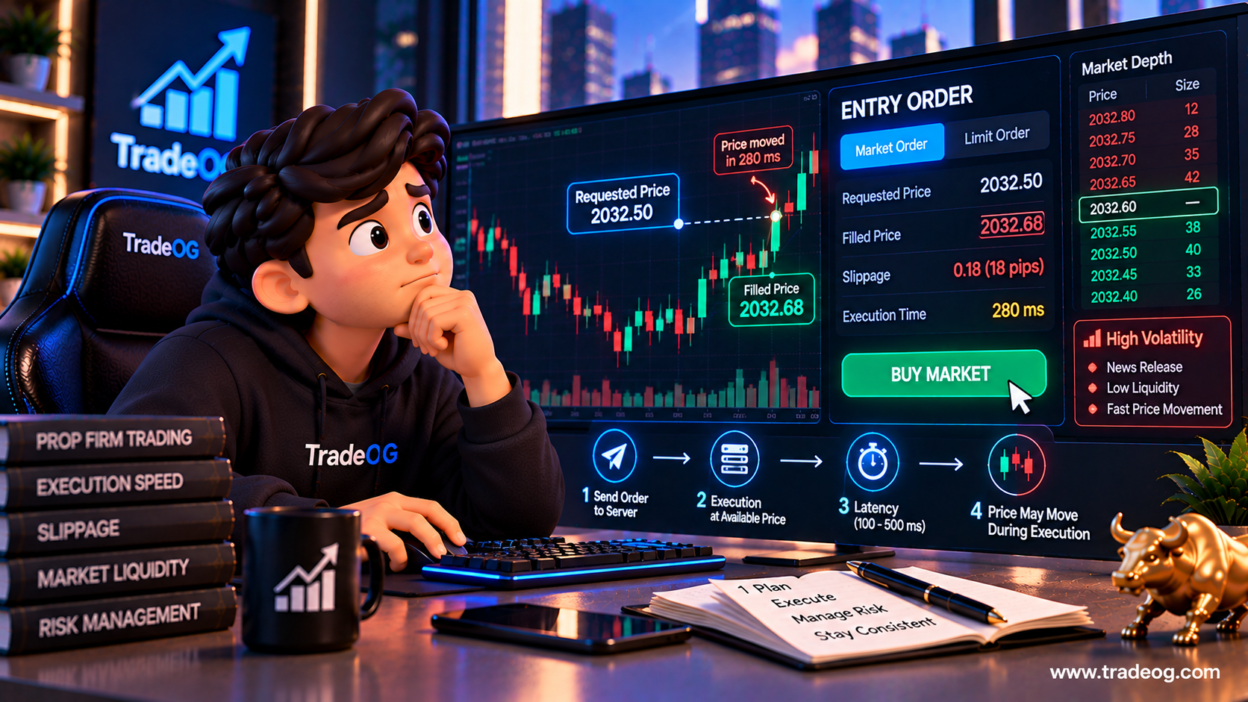
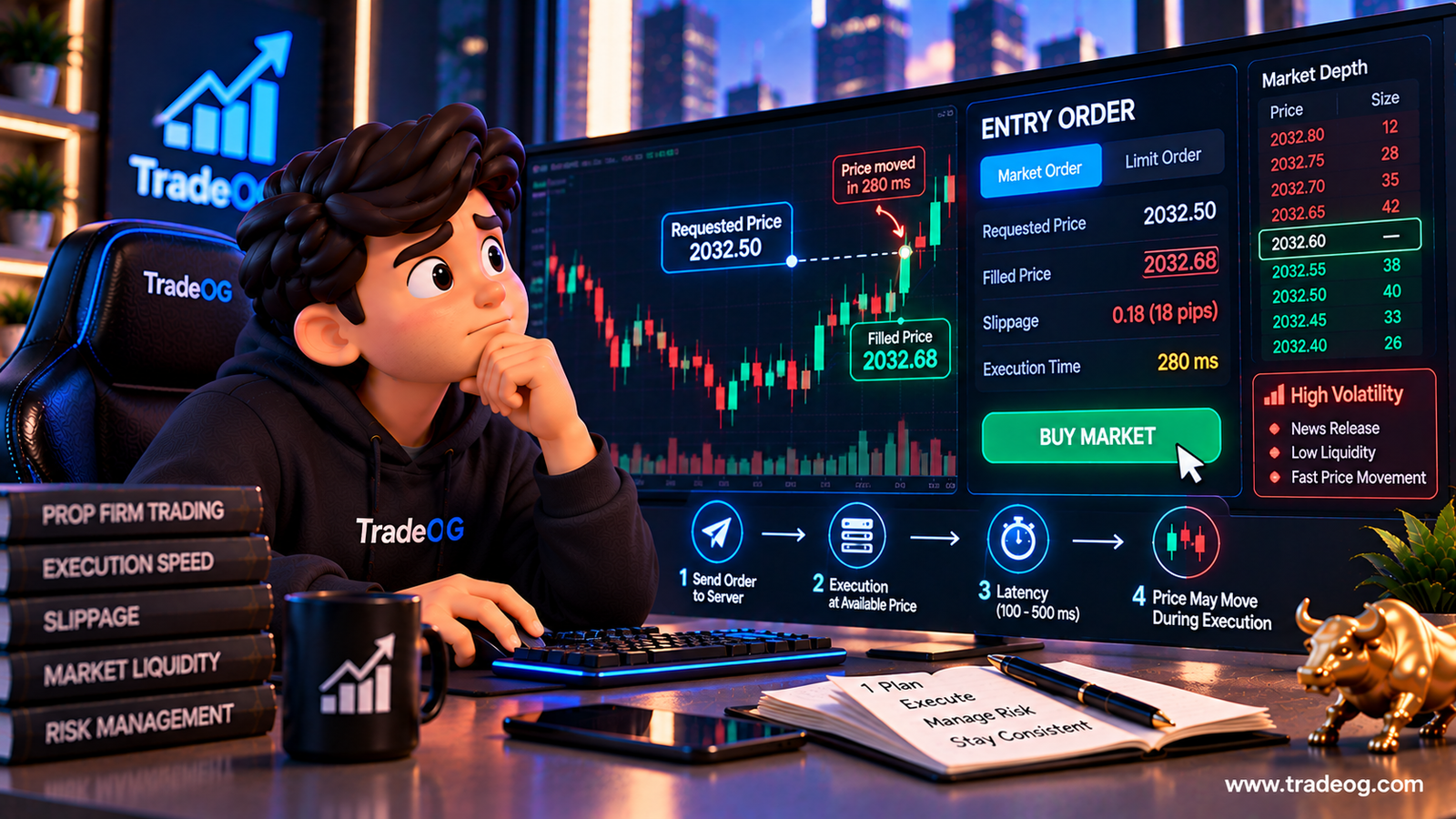
When a trader clicks Buy or Sell, the market price shown on the screen is not necessarily the exact price at which the order will be filled. Between the order request and the completed execution, the price can move, liquidity can change and the order may be filled at the next available price.
For prop firm traders, understanding execution speed matters because even a small difference between the requested entry and actual fill can change the initial stop distance, dollar risk, reward-to-risk ratio and remaining drawdown buffer.
What Is Prop Firm Execution Speed?
Execution speed is the time between submitting an order and receiving the completed fill. It can involve the trading platform, internet connection, broker or liquidity infrastructure, server processing and available market liquidity.
FTMO explains that execution delays can occur in real market trading and says its simulated infrastructure can apply delays of up to 200 milliseconds on certain platforms. FTMO also identifies geographical distance from the server, connection quality and latency as factors that can contribute to execution delays. FTMO technical infrastructure
Why Can the Entry Price Change?
The most important reason is that markets are continuously moving. A trader may see one price when the order is submitted, but the available price can change before the order reaches the execution system.
Topstep describes slippage as the difference between the expected price and the actual fill. Its current guidance identifies volatility, liquidity and market gaps as major drivers. Topstep — Order Types, Fills, and Slippage
A Simple Entry Price Example
Imagine a trader sees an instrument quoted at 2,032.50 and submits a market buy order. During the time required to transmit and execute the order, the available offer moves to 2,032.68.
| Item | Price | Difference |
|---|---|---|
| Expected entry | 2,032.50 | — |
| Actual fill | 2,032.68 | +0.18 |
| Effect | Higher entry cost | Negative slippage |
The order was executed, but not at the price the trader originally saw. If the trader immediately places a fixed-distance stop, the effective risk can therefore be slightly different from the original plan.
Latency vs Slippage
Latency and slippage are related, but they are not identical.
- Latency is the time taken for information or an order to travel through the execution chain.
- Slippage is the difference between the expected or requested price and the actual execution price.
Latency can contribute to slippage when the market moves during that interval. However, liquidity, spread, order size and market conditions also affect the final fill.
Market Orders Prioritize Execution Speed
A market order generally prioritizes getting the trade filled rather than guaranteeing a specific price. Topstep’s current documentation describes market orders as filling at the best available price while noting that the exact price is not guaranteed. Topstep order execution guidance
This makes market orders useful when immediate participation matters, but it also means the trader accepts the possibility of price movement before the fill.
Limit Orders Prioritize Price Control
A limit order allows a trader to specify the maximum price for a buy or the minimum price for a sell. This gives greater price control, but it does not guarantee that the order will fill.
The basic trade-off is therefore:
- Market order: more emphasis on execution, less price certainty.
- Limit order: more price control, less certainty of execution.
Topstep’s educational material describes the same speed-versus-price-control trade-off. Topstep — What Slippage Means in Trading
Why News Can Change Your Entry Quickly
Economic releases and unexpected headlines can move markets rapidly. During high-volatility periods, liquidity can become thinner and spreads can widen, increasing the possibility that an order is filled at a different price.
FundedNext explains that requested prices may become unavailable during high volatility or low liquidity and that orders can then be executed at the next available price. It specifically mentions major news announcements and market openings as situations where slippage can occur. FundedNext — Slippage Explained
Market Depth Also Matters
The price displayed on a platform does not necessarily represent unlimited volume. An order may encounter different prices as it interacts with available liquidity.
FundedNext’s current execution explanation says orders are filled according to prevailing market conditions, the order book and the available volume at a price. This means a fast market or larger order can produce a different fill from the initial quote. FundedNext — Real Market Execution
How Execution Speed Affects Prop Firm Risk
Suppose a trader plans to risk $200 with a stop 20 points from the intended entry. If the actual entry is several points worse because of slippage, the distance between entry and stop changes. Depending on how the stop is structured, the trader may have more or less dollar risk than originally calculated.
This matters even more when the account is close to a maximum loss or daily loss threshold. Small execution differences repeated across multiple trades can accumulate.
Entry Price Changes Can Affect Your Risk-to-Reward Ratio
Consider a trade planned with a 20-point stop and 40-point target. The intended ratio is 1:2. If the entry slips against the trader while the stop and target remain fixed, the actual distances can become different.
For systematic traders, this is one reason to evaluate performance using actual fills rather than assuming that every trade entered at the signal price.
Does Faster Execution Always Mean Better Execution?
Not necessarily. Faster transmission can reduce the time during which the market can move, but execution quality also depends on liquidity, spread, order type, market conditions and the available price at the time of execution.
A very fast order that receives a poor fill is not automatically better than a slightly slower order that receives a more suitable fill. The objective is to understand the execution model and align the order type with the trading strategy.
How Prop Traders Can Monitor Execution Speed
- Record the price visible immediately before sending the order.
- Record the actual fill price.
- Record the timestamp of the order and fill where the platform provides it.
- Compare results during normal and high-volatility sessions.
- Track average adverse and favourable slippage separately.
- Review whether order size changes the execution result.
Execution Speed Checklist
- Is your internet connection stable?
- Where is the trading server or execution infrastructure located?
- Does your platform show order and fill timestamps?
- Are you using a market, limit or stop order?
- Is the market currently highly volatile?
- Is liquidity thinner than usual?
- Could an economic release occur during the trade?
- Is the planned risk still acceptable after accounting for possible slippage?
Common Mistakes
- Assuming the chart price is guaranteed to become the entry price
- Confusing latency with slippage
- Using market orders while expecting exact price control
- Ignoring liquidity and spread conditions
- Calculating risk from the signal price instead of the actual fill
- Trading oversized positions during fast markets
- Ignoring the prop firm’s current execution rules
Final Takeaway
Entry price can change because a market is moving while an order travels through the execution process. Latency can contribute to the difference, but liquidity, volatility, spread, order type and market depth also matter.
For prop firm traders, the practical lesson is simple: calculate risk from the actual fill, understand the trade-off between execution speed and price control, and leave enough drawdown buffer to accommodate normal execution variation.