

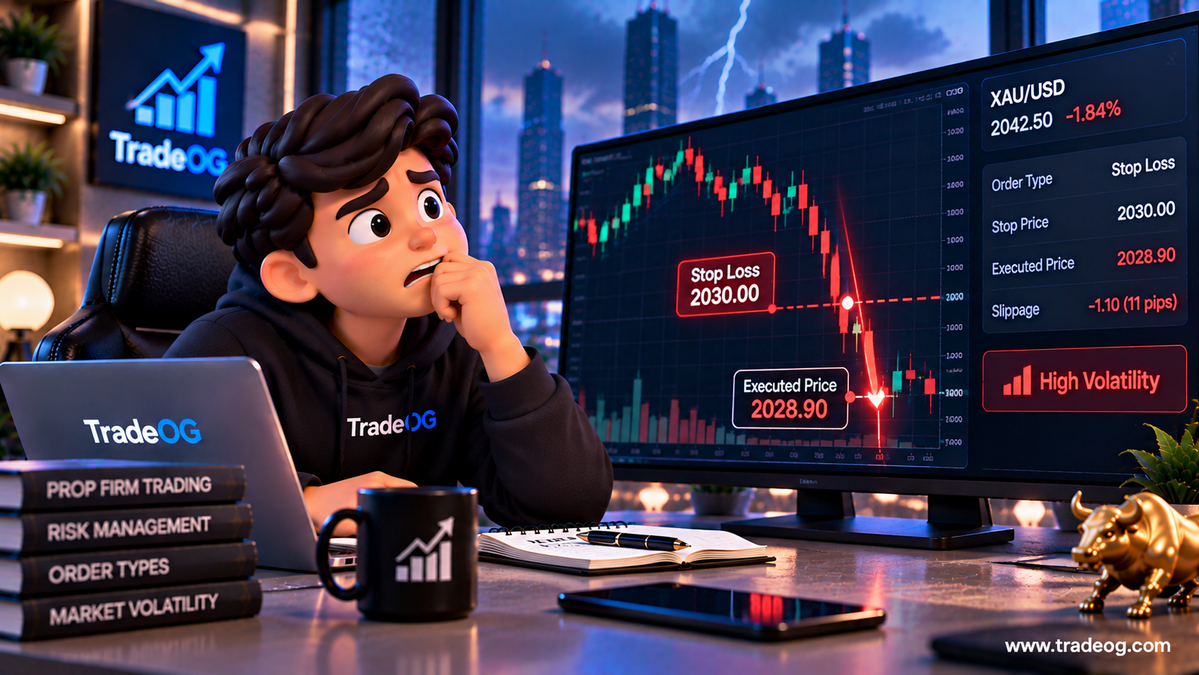
When markets move quickly, a stop order can behave very differently from the price a trader sees on the chart. A stop order is designed to trigger when a specified price is reached, but the resulting execution can occur at a different price when liquidity changes rapidly. For prop firm traders, that difference matters because slippage can increase the realized loss on a position and reduce the remaining drawdown buffer.
This guide explains how stop orders work during volatile markets, why slippage occurs, how stop-loss execution differs from a guaranteed exit, and what prop traders should check before trading around major news, market opens, gaps, or thin-liquidity periods.
What Is a Stop Order?
A stop order becomes active when the market reaches a predefined trigger price. A buy stop is normally placed above the current market price, while a sell stop is normally placed below it. Once triggered, a conventional stop order can be executed using the available market liquidity rather than guaranteeing the exact trigger price.
FTMO Academy explains that a stop order effectively acts as a market order after activation, which means traders need to consider potential slippage, particularly in volatile or low-liquidity conditions.
What Is Stop-Loss Slippage?
Stop-loss slippage is the difference between the stop level a trader expected and the actual execution price. For example, imagine a trader is long XAU/USD at 2,050 and places a stop loss at 2,040. If the market moves rapidly through 2,040 and the position is filled at 2,037, the trader has experienced negative slippage of $3 per ounce relative to the intended stop level.
The stop level still served its purpose as a trigger, but it did not necessarily guarantee that exact execution price. In fast markets, available prices can change between the moment the trigger is reached and the moment the order is filled.
Why Volatile Markets Increase Slippage
Volatility can increase the distance between the requested or trigger price and the available execution price. FTMO notes that slippage can become significant during volatile or illiquid markets, including major news releases and market rollovers. Spreads can also widen when liquidity becomes scarce.
Common situations include:
- High-impact economic news
- Sharp market opens
- Unexpected geopolitical or macroeconomic headlines
- Weekend or session gaps
- Market rollover periods
- Thin liquidity in particular instruments or trading sessions
- Large orders relative to available market depth
FTMO’s current educational material distinguishes between positive and negative slippage. Negative slippage moves execution against the trader, while positive slippage can produce a more favourable fill.
Stop Price vs Executed Price: A Simple Example
Consider a hypothetical $50,000 prop account with a trader holding a futures or CFD position. The trader sets a stop at a level where the planned loss is $400.
| Scenario | Stop Trigger | Actual Fill | Effect |
|---|---|---|---|
| Normal liquidity | Planned level | Near planned level | Small or no slippage |
| Fast market | Planned level | Worse price | Loss increases |
| Large gap | Planned level | Next available price | Loss can increase materially |
| Favourable movement | Trigger level | Better price | Positive slippage may occur |
The important point is that the stop price should not automatically be treated as the exact final loss. The final result depends on execution conditions.
Stop Order vs Stop-Limit Order
A stop order and a stop-limit order manage execution differently. A conventional stop order prioritizes getting the position executed after the trigger is reached. A stop-limit order activates a limit order, allowing the trader to define the worst acceptable price.
The trade-off is important. A stop-limit order can limit unacceptable execution prices, but it can also fail to fill if the market moves beyond the limit price too quickly. FTMO’s order-type guidance describes this trade-off: a stop order can experience negative slippage in thin or volatile markets, while a stop-limit order can remain unfilled when the required limit price is no longer available.
Why This Matters More for Prop Firm Traders
For a prop trader, the relevant risk is not only the planned stop distance. The trader must also consider the remaining account drawdown and the possibility that actual execution differs from the planned stop.
Suppose a trader has $1,000 of remaining drawdown and normally risks $200 per trade. Five planned losses might appear to fit the remaining cushion exactly. But if several exits experience negative slippage, the actual losses could exceed the planned $200 per trade. A strategy that appears acceptable on paper can therefore become much more fragile during volatile conditions.
This is why a drawdown buffer should be treated separately from the theoretical stop-loss distance. The closer an account is to its maximum loss threshold, the more significant unexpected execution costs can become.
News Releases Can Create Fast Stop Execution
Major economic releases can produce rapid price changes, wider spreads and changing liquidity. FTMO specifically identifies significant news releases as an environment where slippage can occur, while FundedNext’s current news-trading guidance warns that volatility, wider spreads and slippage can affect Stop Loss, Take Profit and other pending-order execution.
Prop firm rules are not identical, so traders should read the firm’s current news-trading policy before assuming that a stop order will be treated in a particular way. A firm can also apply different rules to challenge, evaluation and funded accounts.
FundedNext’s current news-trading guidance is one example of a firm-specific policy. The exact restrictions and account models can change, so the firm’s current help-center documentation should be checked before trading scheduled announcements.
Market Gaps and Stop Orders
A gap creates a special execution problem because the market can move from one price area to another without trading continuously through every intermediate price. If a stop is located inside that gap, the order may be triggered and filled at the next available price rather than the exact stop level.
This is particularly relevant to traders who hold positions through weekends, market closures or major scheduled events. A stop-loss plan should therefore account for gap risk rather than assuming that the stop price is an absolute guarantee.
Liquidity and Order Size
Liquidity refers to the availability of buyers and sellers at different prices. When liquidity is deep, an order may be absorbed with relatively little price impact. When liquidity becomes thin, the available prices can change more quickly.
Large position sizes can make this issue more important. Even if an instrument is normally liquid, a sudden reduction in available liquidity can increase execution differences. Prop traders should therefore evaluate contract size, volatility and the firm’s drawdown threshold together rather than looking at stop distance alone.
Does a Stop Loss Guarantee the Exact Price?
Not necessarily. A conventional stop order is generally a trigger mechanism, not an unconditional guarantee of an exact fill. The actual execution depends on the market and execution model.
FTMO states that orders are filled according to available market conditions and that slippage can occur when prices change or when there is insufficient availability at the requested level. Its material also notes that slippage can be positive or negative.
FTMO’s slippage and order-execution guide provides a detailed explanation of how volatility, liquidity, spread widening and gaps can affect execution.
How to Calculate the Impact of Slippage
A simple way to estimate the effect is:
Additional Loss From Slippage = Slippage Distance × Dollar Value Per Point × Position Size
For example, if a position experiences 2 points of adverse slippage and the position value is $10 per point, the additional loss is approximately $20.
For futures, always use the contract’s actual dollar value per point. Micro and Mini contracts can have materially different point values, so the same chart movement can create very different dollar outcomes.
Five Ways Prop Traders Can Reduce Stop-Execution Risk
- Keep a drawdown buffer. Do not size every trade right up to the account’s theoretical loss threshold.
- Reduce size during extreme volatility. Smaller exposure reduces the dollar effect of unexpected execution differences.
- Know the firm’s news rules. Check whether opening, closing or holding positions around specific releases is restricted.
- Understand your order type. Know whether your platform uses a conventional stop, stop-limit, trailing stop or another mechanism.
- Review actual fills. Compare stop trigger levels with execution prices after volatile trades so you understand the real slippage your strategy experiences.
Common Mistakes Traders Make
- Assuming the stop price is always the final exit price
- Using the same position size in calm and highly volatile markets
- Ignoring spread widening around major events
- Trading too close to a prop firm’s maximum loss threshold
- Confusing a stop-limit order with a guaranteed fill
- Ignoring gaps when holding positions outside normal market conditions
- Failing to read the firm’s current execution and news policies
Stop Orders and Prop Firm Drawdown: Practical Checklist
Before entering a trade, ask:
- How much remaining drawdown does the account have?
- What is the planned stop distance?
- What is the dollar value of the instrument or contract?
- Could a scheduled news event occur during the trade?
- Is current liquidity normal?
- Could a gap occur before the position is closed?
- What does the prop firm’s current rulebook say about news and execution?
- Would one unusually large slippage event materially affect the account?
Final Takeaway
Stop orders are an important risk-management tool, but the trigger price should not automatically be treated as a guaranteed execution price. During volatile or low-liquidity conditions, negative slippage can increase realized losses. For prop firm traders, that additional loss matters because it directly reduces the remaining drawdown cushion.
The practical approach is to combine the stop distance with position size, contract value, market conditions, expected volatility and the firm’s specific rules. A stop is part of a risk plan; it should not be the only part.

[…] Prop Firm Stop Orders and Slippage During Volatile Markets […]