

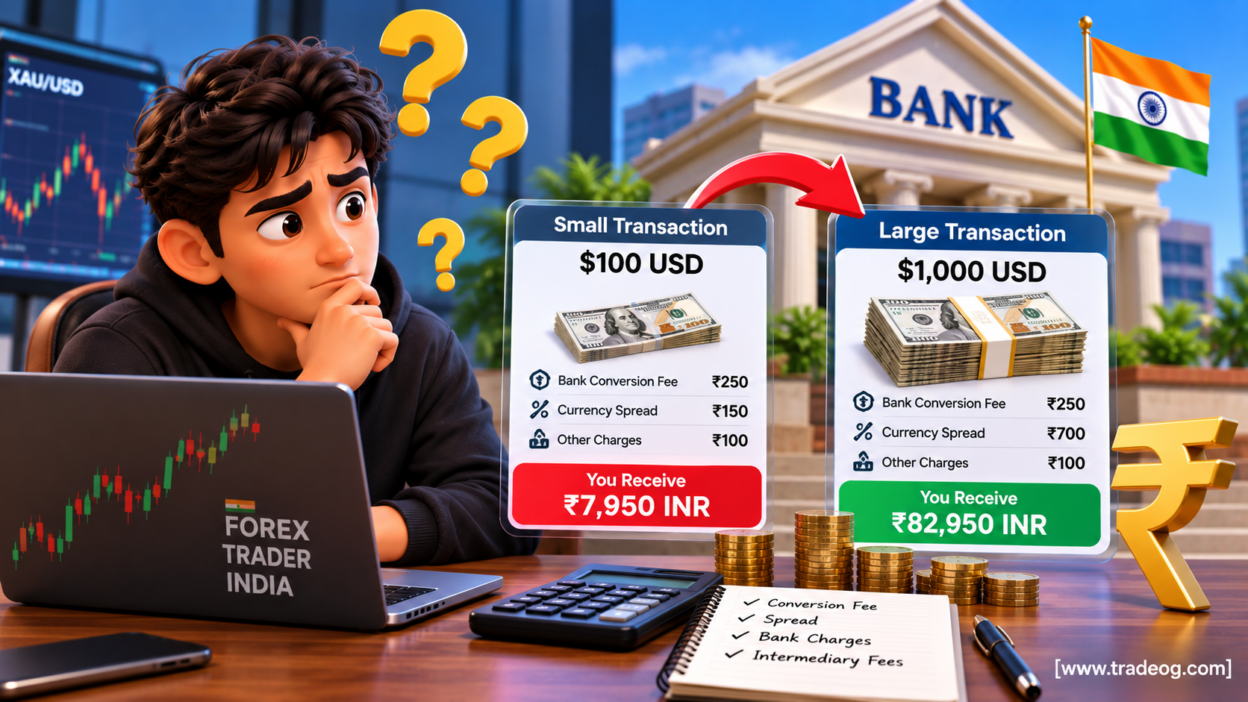
For an Indian trader, a small forex withdrawal can sometimes feel surprisingly expensive after it is converted from USD or another foreign currency into INR. The reason is simple: some costs are fixed or have minimum charges, while the withdrawal amount is small. The same ₹200–₹500 of charges that barely matters on a large withdrawal can take a meaningful percentage out of a smaller payment.
This is why a $100, $200 or $300 withdrawal may give you a much lower effective INR value than you expected when you calculate it using a headline USD/INR rate. The difference can come from a combination of bank charges, foreign exchange spreads, intermediary-bank costs and the conversion rate actually applied to the transaction.
Why Small Forex Transactions Can Cost More
The key issue is fixed cost versus transaction size. Suppose a payment provider, bank or intermediary effectively costs you ₹300 on a transaction. On a ₹8,000 equivalent withdrawal, ₹300 is 3.75%. On a ₹80,000 withdrawal, the same ₹300 is only 0.375%.
The charge itself has not necessarily become larger. Your transaction has simply become large enough for the fixed cost to represent a smaller percentage of the money being converted.
There can also be a second effect: the exchange rate you receive may be different from the mid-market rate you see on Google or a currency website. Banks and payment providers can apply their own foreign exchange rate or spread.
Fixed Fees Hurt Small Withdrawals the Most
A fixed fee is particularly important when you are converting a small amount. For example, imagine a hypothetical ₹250 processing or conversion-related charge.
| Withdrawal equivalent | Illustrative fixed cost | Cost as % of withdrawal |
|---|---|---|
| ₹8,000 | ₹250 | 3.13% |
| ₹20,000 | ₹250 | 1.25% |
| ₹50,000 | ₹250 | 0.50% |
| ₹1,00,000 | ₹250 | 0.25% |
These figures are only an illustration. They are not a standard bank fee schedule. Actual charges depend on the bank, payment route, currency, intermediary institutions and the terms applicable to your transaction.
Currency Conversion Spread Can Add Another Cost
The exchange rate is another major factor. The rate shown on a public currency converter is usually useful as a reference, but the rate used for an actual bank conversion may differ.
For example, if the reference rate is ₹84 per USD but the effective conversion rate applied to a transaction is ₹83.50, a $200 withdrawal would have a gross difference of ₹100 before considering any separate charges.
Again, this is an illustrative calculation rather than a quoted bank rate. The important point is that a small difference in the exchange rate becomes a real rupee difference when multiplied by the foreign-currency amount.
Why a $100 Withdrawal Can Feel Expensive
Consider a hypothetical $100 withdrawal. At an illustrative rate of ₹84 per USD, the gross value would be ₹8,400.
Now assume the overall transaction has ₹250 in fixed costs and the effective FX rate is slightly worse than the reference rate. The amount finally credited to your Indian bank account could be materially below the ₹8,400 figure you calculated.
This is why traders should compare the net INR received, not simply the broker’s withdrawal amount.
Small Withdrawal vs Large Withdrawal
Suppose two traders use the same payment route. One withdraws $100 and another withdraws $1,000. If the transaction includes a fixed component, the smaller withdrawal carries a much higher effective cost.
| Example | $100 withdrawal | $1,000 withdrawal |
|---|---|---|
| Reference value at ₹84/USD | ₹8,400 | ₹84,000 |
| Illustrative fixed costs | ₹250 | ₹250 |
| Fixed cost percentage | 2.98% | 0.30% |
The fixed charge is identical in this example, but its percentage impact is almost ten times higher on the smaller withdrawal.
Bank Charges, FX Spread and Intermediary Fees Are Different
One reason traders get confused is that several different costs may appear around the same transaction.
- Bank or processing charge: a fee associated with handling the transaction.
- FX conversion spread: the difference between a reference exchange rate and the rate offered for conversion.
- Intermediary-bank charge: a cost that can arise when an international payment passes through another financial institution.
- Payment-provider fee: a charge applied by the payment service or withdrawal method.
- Correspondent or receiving-bank deductions: depending on the payment route and applicable terms.
Not every transaction will have all of these costs. The exact structure depends on the provider and payment method.
Why the Google USD to INR Rate May Not Match Your Bank Credit
It is normal for traders to search for the USD/INR rate before estimating a withdrawal. However, a public reference rate is not necessarily the same rate your bank will use for an actual conversion.
Your transaction can be affected by the time at which the conversion is processed, the institution’s applicable rate, the transaction route and any spread or charges built into the conversion.
For a practical explanation of why the amount on a bank statement may differ from the expected withdrawal, see our guide on why a bank statement can show a different forex withdrawal amount.
Should You Wait and Withdraw a Larger Amount?
Not automatically. Consolidating several small withdrawals can reduce the percentage impact of fixed charges if the payment provider and bank actually charge per transaction. But traders should not delay a withdrawal solely because of a theoretical fee saving.
Before changing your withdrawal behaviour, check the provider’s terms, your bank’s applicable charges, the payment method and any relevant tax or regulatory requirements. A larger transaction is not automatically cheaper in every situation.
How Indian Traders Can Reduce the Impact
- Check the net INR amount. Compare what actually reaches your bank account with the foreign-currency amount sent.
- Ask your bank about the applicable FX rate. Do not assume the public USD/INR rate will be used.
- Ask whether any fixed receiving or processing fee applies.
- Check for intermediary deductions. International transfers can involve more than one institution.
- Compare payment methods where permitted. Different withdrawal methods can have different costs.
- Keep records. Save the withdrawal confirmation, bank credit entry and any transaction advice so you can calculate the true effective rate.
- Do not use an unauthorised route simply because it appears cheaper. Lower fees are not a substitute for using a lawful and permitted payment channel.
How to Calculate Your Effective INR Conversion Rate
A simple way to measure the result is:
Effective INR Rate = Net INR Received ÷ Foreign Currency Amount Received
For example, if a $200 withdrawal results in ₹16,300 credited to your account, your effective rate is ₹81.50 per USD. You can then compare that result with the relevant reference rate and investigate the difference.
This calculation is more useful than looking only at a broker’s “withdrawal completed” message.
What If the Withdrawal Shows Completed but You Receive Less?
A completed withdrawal usually describes the status of the payment on the sender’s side. It does not necessarily mean the exact gross foreign-currency value will arrive in your account as an identical INR amount.
Currency conversion and banking deductions can happen during or after the payment process, depending on the route. If the difference looks unusually large, ask the bank or payment provider for the transaction details and applicable conversion rate.
If your withdrawal is taking longer than expected, you may also find our guide on why a forex broker withdrawal can take longer in India useful.
Forex Withdrawals and Indian Regulatory Considerations
Indian residents should also distinguish between the cost of converting a legitimate foreign-currency receipt and the legality of the underlying forex activity or payment route.
The Reserve Bank of India has cautioned residents against unauthorised forex trading platforms and states that permitted electronic forex transactions should be undertaken through authorised electronic trading platforms or recognised stock exchanges, subject to applicable rules. Traders should verify the status and permitted nature of any platform or transaction rather than choosing a route only because it has lower charges.
Frequently Asked Questions
Why do small forex withdrawals have a higher percentage cost?
Because fixed charges represent a larger percentage of a small transaction. A ₹250 cost is much more significant on ₹8,000 than on ₹80,000.
Is the USD/INR rate shown online the rate my bank will use?
Not necessarily. Online reference rates and actual bank conversion rates can differ because banks and payment providers may apply their own applicable rates and spreads.
Are all small forex withdrawals expensive?
No. Costs vary by provider, bank, currency, payment method and transaction route. The important step is to calculate the net amount actually received.
Can combining withdrawals reduce costs?
It can reduce the percentage impact of a fixed per-transaction fee in some situations, but it depends on the provider’s fee structure. Do not assume consolidation is always cheaper.
How can I find my real forex conversion cost?
Compare the foreign-currency amount sent with the final INR amount credited, then check the applicable conversion rate and any separate charges shown by the bank or payment provider.
Final Takeaway
Small forex transactions can feel expensive to convert into INR because fixed charges, minimum fees and exchange-rate spreads consume a larger percentage of the withdrawal. The solution is not to focus only on the headline USD/INR rate. Instead, calculate the effective INR amount received after all applicable costs.
For Indian traders, keeping a record of the withdrawal amount, conversion rate, bank credit and transaction charges makes it much easier to understand where the difference came from and to compare withdrawal methods responsibly.
Disclaimer: This article is for educational and informational purposes only. Fee structures, exchange rates, banking practices and payment routes can change. Illustrative calculations in this article are examples, not quoted bank or broker fees. Always verify applicable charges, regulatory requirements and payment terms directly with the relevant authorised bank, payment provider or official source before making financial decisions.
