
A U.S. Treasury bond auction can look like a fixed-income event that has little to do with gold. For XAU/USD traders, however, a surprisingly strong or weak auction can become a fast-moving macro catalyst.
The reason is simple: Treasury auctions help the market discover the price investors are willing to pay for U.S. government debt. When demand is very different from expectations, Treasury yields can jump or fall, the U.S. dollar can reprice, and traders can quickly adjust expectations for interest rates, inflation, liquidity and risk. Gold sits directly in the middle of several of those relationships.
That does not mean every weak auction makes gold rally or every strong auction makes gold fall. The important question is what the auction changes in the broader market narrative.
What Is a U.S. Treasury Bond Auction?
The U.S. Treasury regularly sells government securities through auctions. Investors submit bids, and the Treasury accepts competitive bids from the lowest yield upward until the amount being offered is allocated. Successful bidders receive the same stop-out yield. citeturn0search12
Traders usually focus on several pieces of the result:
- Bid-to-cover ratio: how much total demand was submitted relative to the amount offered.
- High yield or stop-out yield: the yield at which the auction clears.
- Auction tail: the difference between the auction yield and the yield in the when-issued market immediately before the auction.
- Indirect and direct bidders: indicators that help traders understand where demand came from.
None of these numbers is a gold signal by itself. Their importance comes from how the bond market interprets them versus expectations.
Why Can a Bond Auction Move XAU/USD?
The transmission mechanism usually looks like this:
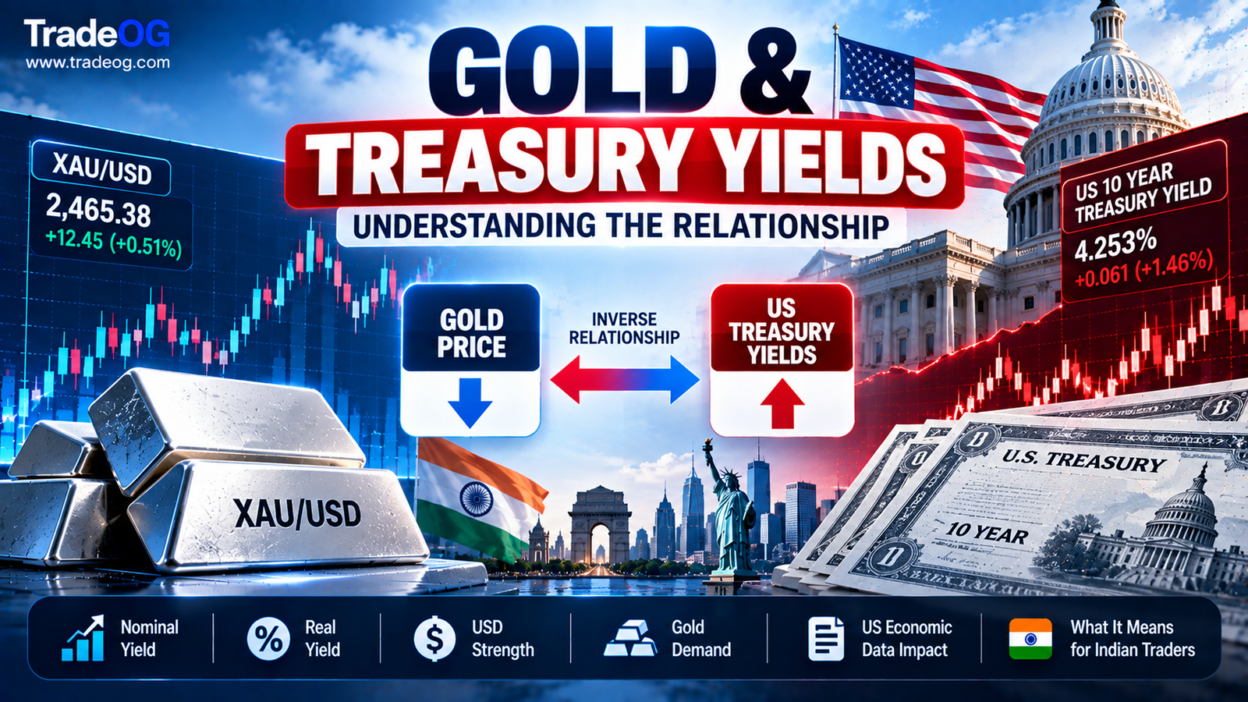
Auction result → Treasury yields → real yields and rate expectations → U.S. dollar/liquidity → XAU/USD.
There can also be a second channel:
Auction result → concern or confidence about debt demand → broader risk sentiment → demand for safe-haven assets.
This is why an auction can sometimes produce a counterintuitive gold move. Gold is influenced by opportunity cost, the dollar, real yields, investment flows and risk. A bond-market shock can affect several of those variables simultaneously.
What Happens When a Treasury Auction Is Strong?
Imagine the market expected an ordinary auction, but demand turns out to be much stronger. The Treasury can clear the securities at a lower yield than traders expected, while Treasury prices rise.
That can create an initial bearish environment for XAU/USD because lower yields reduce the opportunity cost of holding a non-yielding asset such as gold. If the U.S. dollar also weakens because investors interpret the result as a sign of softer rate pressure, the reaction can become even more supportive for gold.
But context matters. A strong auction may also improve confidence in the Treasury market and reduce financial stress. If risk appetite improves at the same time, gold may not immediately rally despite lower yields.
Typical bullish setup for gold
- Strong auction demand
- Treasury yields fall
- Real yields fall or rate expectations become less restrictive
- DXY weakens
- Gold breaks or holds above important technical levels
When several of those conditions appear together, a strong auction can become a meaningful bullish catalyst for XAU/USD.
What Happens When a Treasury Auction Is Weak?
Now consider the opposite. Suppose the market expects strong demand, but the auction clears at a noticeably higher yield than the prevailing when-issued level. The bond market may interpret that as weaker-than-expected demand.
Bond prices can fall and Treasury yields can rise. If the move is driven by expectations of higher inflation, stronger growth or tighter monetary policy, the U.S. dollar can also strengthen.
That combination is often a headwind for gold.
World Gold Council research has repeatedly highlighted the importance of U.S. rates and the dollar for gold. Its analysis has also shown that higher yields can create an opportunity-cost headwind, although the relationship is not constant across every market regime. citeturn0search1turn0search9
Typical bearish setup for gold
- Weak auction demand
- Yields jump
- Real yields move higher
- DXY strengthens
- Risk assets remain stable enough for traders to favor higher-yielding dollar assets
In that environment, XAU/USD can sell off sharply, particularly if the market was already positioned for lower yields.
The Auction “Tail” Can Matter More Than the Headline
A common mistake is looking only at the bid-to-cover ratio.
Suppose an auction has a respectable bid-to-cover ratio but clears at a materially higher yield than the when-issued market. That difference can tell traders that the headline demand number did not translate into strong price-insensitive demand at the expected level.
The auction tail therefore deserves attention. U.S. Treasury materials define the auction tail as the auction yield minus the yield in when-issued trading. citeturn0search24
For XAU/USD traders, the practical question is not “Was bid-to-cover high?” It is:
“Did the result force the Treasury market to reprice yields?”
Why Real Yields Matter for Gold
Nominal Treasury yields are important, but gold traders should also watch real yields, especially the U.S. 10-year TIPS yield.
Real yields represent the inflation-adjusted return available from U.S. government debt. When real yields rise sharply, the relative opportunity cost of holding gold can increase. When real yields fall, that pressure can ease.
Recent World Gold Council research has also emphasized that the gold-rate relationship is regime-dependent. In some periods, higher rates have hurt gold; in others, currency weakness, fiscal concerns, central-bank demand or risk uncertainty have outweighed the rate effect. citeturn0search2turn0search10
That is why a bond auction should be treated as a macro input, not as a mechanical buy-or-sell signal.
Watch DXY After the Auction
The U.S. dollar is often the missing piece when traders analyze gold’s reaction to Treasury events.
If a disappointing auction pushes Treasury yields higher and the dollar higher, XAU/USD can face a double headwind. If yields rise but the dollar falls because markets interpret the move as a fiscal-risk problem rather than a simple rate repricing, gold can behave very differently.
This distinction has become particularly important as investors have paid more attention to fiscal concerns and the sustainability of government debt. The World Gold Council has noted that fiscal stress can support gold as investors diversify toward alternative safe-haven assets. citeturn0search2
In other words, higher yields are not automatically bearish for gold. You need to know why yields are rising.
Three Common XAU/USD Auction Scenarios
1. Strong auction + falling yields + weaker DXY
This is the cleanest bullish combination. Gold benefits from lower opportunity cost and a softer dollar. If technical structure also supports the move, momentum traders may join quickly.
2. Weak auction + rising yields + stronger DXY
This is the classic bearish combination. Gold can fall as traders price a higher return from U.S. assets and a stronger dollar.
3. Weak auction + rising yields + falling DXY
This is the interesting one. If the dollar falls while long-term yields rise, markets may be interpreting the auction as a fiscal or confidence problem rather than simply a stronger-growth/higher-rates story. Gold can hold firm or even rally as a safe-haven alternative.
World Gold Council commentary in 2026 has specifically noted that long-term Treasury yields can reflect fiscal and inflation concerns differently from short-term yields, which helps explain why the dollar and gold do not always respond mechanically to higher long-term rates. citeturn0search7
How Forex Traders Should Trade a Bond Auction Surprise
Do not enter XAU/USD immediately just because an auction headline appears on your calendar. The first seconds can be dominated by liquidity gaps, spread expansion and algorithmic positioning.
A more disciplined approach is to wait for the market to reveal the direction of the repricing.
- Check the auction result. Compare the stop-out yield with the market’s expectation and the when-issued level.
- Check the Treasury reaction. Look at the relevant 2-year, 5-year, 10-year or 30-year yield depending on the auction.
- Check real yields. If available, compare the move in nominal yields with TIPS yields.
- Check DXY. Is the dollar confirming the gold move or contradicting it?
- Check XAU/USD structure. Wait for a breakout, rejection, retest or continuation pattern instead of chasing the first spike.
- Control risk. Auction releases can produce fast candles and temporary whipsaws.
For traders using prop-firm accounts, this last point matters even more. A correct macro idea can still become a losing trade if the position is oversized during a liquidity shock.
Why the First Gold Move Can Be Misleading
XAU/USD does not always move in a straight line after a bond auction.
Imagine a weak auction initially pushes the 10-year yield higher. Gold sells off for two minutes. Then investors begin focusing on the reason for the weak demand: perhaps the market is worried about fiscal sustainability. The dollar starts falling, Treasury yields reverse, and gold recovers the entire move.
This type of reversal is why experienced traders separate the headline reaction from the second-order reaction.
The first move tells you what algorithms saw. The second move often tells you what discretionary macro investors actually believe.
Bond Auction vs Fed Decision: Which Matters More for Gold?
A Federal Reserve decision directly changes the policy-rate outlook, so it normally has a larger scheduled impact on gold. A Treasury auction is different: it provides information about demand for government debt and can influence the market’s perception of yields, liquidity and fiscal risk.
However, a badly received auction can matter a lot when the bond market is already under stress. In that environment, a relatively small auction surprise can produce a larger move because positioning and liquidity are already fragile.
What Indian XAU/USD Traders Should Watch
For traders in India, the global XAU/USD reaction is still the key reference because international gold is priced in U.S. dollars. But USD/INR can change the local rupee value of gold.
That means an XAU/USD move and the Indian domestic gold-price reaction do not always have identical magnitudes. A stronger or weaker rupee can amplify or reduce the effect.
Indian traders should therefore watch:
- XAU/USD
- DXY
- U.S. 10-year Treasury yield
- U.S. 10-year real yield
- USD/INR
- Major U.S. economic releases scheduled around the auction
Final Takeaway
A surprising U.S. Treasury auction matters to XAU/USD because it can change the market’s view of yields, real rates, the dollar and financial risk within minutes.
The simplest framework is:
Strong demand → yields lower → gold potentially supported.
Weak demand → yields higher → gold potentially pressured.
But the better framework is more nuanced: follow the reason behind the yield move. If yields rise because markets expect stronger growth and tighter policy, gold can struggle. If yields rise because investors are demanding compensation for fiscal or inflation risk, gold may behave much better than a simple yield-versus-gold rule would suggest.
For XAU/USD traders, the auction is therefore not the trade. The repricing that follows the auction is the trade.
Frequently Asked Questions
Does a weak US Treasury auction always make gold fall?
No. A weak auction can push yields higher and pressure gold, but if the market interprets the result as a fiscal-risk or confidence problem, gold can instead benefit from safe-haven demand or a weaker dollar.
Which Treasury yield should gold traders watch?
The 10-year Treasury yield is a useful benchmark for longer-term market expectations, while the 2-year yield is closely tied to expectations for monetary policy. For gold, real yields such as the 10-year TIPS yield are also important.
What is an auction tail?
The auction tail is the difference between the yield at which the Treasury auction clears and the yield in the when-issued market immediately before the auction. A meaningful tail can signal that the market had to reprice to absorb the supply.
Can gold rise when Treasury yields rise?
Yes. Gold’s relationship with rates is not mechanical. Dollar weakness, fiscal concerns, geopolitical risk, central-bank demand and investment flows can outweigh the negative effect of higher yields.
Should traders buy XAU/USD immediately after an auction surprise?
Not necessarily. The initial reaction can be volatile and liquidity can be thin. It is usually safer to wait for confirmation from Treasury yields, DXY and the XAU/USD price structure before deciding whether the move has genuine follow-through.
Related TradeOG reading: Gold and US Treasury Yields: Understanding the Relationship, What Is Real Yield and Why Does It Matter for Gold Traders?, Why Gold Sometimes Rises When the Dollar Also Rises, and Gold Volatility Explained: Why XAU/USD Can Move So Fast.