


Before trading XAUUSD with a prop firm, check at least eight things: news restrictions, leverage, spread, commission, daily and maximum drawdown, trading hours, overnight/weekend rules, and prohibited strategies. Gold can move quickly and its spread and execution conditions can change around major news and low-liquidity periods, so the rules for your specific firm and account should be verified before placing a trade.
A common mistake among retail traders entering the proprietary trading industry is assuming that if a firm lists gold on its platform, trading it follows the exact same parameters as trading EUR/USD or GBP/USD. In reality, XAUUSD availability does not mean every gold-trading condition is identical across firms. Gold features unique leverage tiers, specialized commission models, elevated rollover spread risks, and strict event-driven restrictions that can terminate an evaluation account in seconds if misunderstood.
Can You Trade XAUUSD With a Prop Firm?
Often yes, but availability, platform specifications, and operational rules vary significantly from firm to firm.
While gold (XAU/USD) is one of the most widely offered instruments across modern prop firms, the environment in which you trade it is rarely standardized:
- Instrument Availability: Most firms include XAU/USD under their commodities or metals offerings, but some firms restrict it on specific algorithmic or micro-account tiers.
- Tiered Leverage: Gold leverage is almost universally lower than foreign exchange currency leverage due to underlying asset volatility.
- Custom Trading Hours: Gold does not trade continuously 24 hours a day; it features mandatory daily session breaks and weekend halts.
- Event Restrictions: Because gold reacts violently to US macroeconomic releases, several firms restrict trading gold during high-impact news windows.
- Drawdown Sensitivity: Because standard gold contracts feature a high notional multiplier (100 oz per lot), tick movements impact equity-based drawdown meters much faster than major currency pairs.
For example, FTMO currently lists commodities (including XAU/USD) among its tradable instruments and permits discretionary, technical, and algorithmic approaches provided they adhere to platform rules and legitimate market conditions. However, this general access comes with specific parameters governing leverage and news execution that differ from other prop firms.
The 10 XAUUSD Rules You Should Check Before Trading
Before submitting your first gold order on any evaluation or funded account, systematically audit these ten operational rules:
- News Trading Restrictions: Are you prohibited from opening or closing gold positions around high-impact announcements?
- XAUUSD Leverage Limits: What is the exact margin requirement for metals on your specific account tier?
- Live Execution Spread: What is the daytime average spread versus the off-peak / rollover spread?
- Commission Model: Is commission charged as a flat rate per lot or as a percentage of notional value?
- Daily Drawdown Mechanics: Does the daily loss limit evaluate live equity ticks or closed cash balance?
- Maximum Drawdown Type: Is your lifetime drawdown static, balance-trailing, or equity-trailing?
- Overnight Holding Rules: Does your account tier require closing gold positions before the daily session break?
- Weekend Holding Rules: Are you permitted to carry gold trades through the Friday market close?
- Daily Trading Hours & Halts: At what exact server times does the gold market close for daily clearing?
- Prohibited Strategy Policies: Does the firm restrict tick-scalping, latency arbitrage, or news bracketing on gold?
Never assume another trader’s prop-firm rules apply to your account. Even within the same firm, an evaluation challenge, a funded account, and a dedicated swing account often operate under distinct rulebooks.
XAUUSD News Trading Rules for Prop Firm Traders
Related: US news gold trading and gold spread rules.
Gold is denominated in US dollars and operates as both a monetary hedge and a speculative risk asset. Consequently, it exhibits extreme sensitivity to US macroeconomic data. Releases that trigger violent price repricing include:
- Consumer Price Index (CPI) & Core Inflation Data
- Non-Farm Payrolls (NFP) & Unemployment Reports
- FOMC Interest Rate Decisions & Press Conferences
- Federal Reserve Monetary Policy Statements
- US Gross Domestic Product (GDP) Releases
To insulate themselves against toxic flow and execution slippage during these releases, prop firms establish clear boundaries that typically fall into one of two models:
Real-World Prop Firm News Comparison (Firm-Specific Examples):
FTMO News Policy:
FTMO currently documents that for applicable FTMO Accounts (specifically standard funded tiers), selected macroeconomic news releases restrict opening or closing trades on affected instruments—explicitly including Gold (XAUUSD)—within a 2-minute window before and after the announcement. However, FTMO explicitly exempts its FTMO Challenge, Verification, and dedicated FTMO Swing accounts from this restriction.
The5ers News Policy:
The5ers documents that its news restrictions depend strictly on the selected program. Under its High Stakes program, traders are permitted to hold existing positions over news events, but order execution (opening, closing, or triggering pending orders) around high-impact news events is restricted according to its published server-time calendar.
This comparison demonstrates why generalized assumptions fail: two leading firms approach gold news restrictions with fundamentally different operational models. For a comprehensive analysis of execution friction during macroeconomic releases, read our guide on XAUUSD news slippage.
Does the News Rule Apply to Pending Orders?
Yes, in almost all prop firms that enforce news restrictions.
A dangerous misconception among challenge traders is believing that setting a Buy Stop, Sell Stop, Buy Limit, or Sell Limit hours before a news release makes the trade compliant. It does not.
Prop firm risk monitoring systems evaluate the timestamp of execution, not the timestamp when the order was placed. If you set a Buy Stop at 12:00 PM, and a surprise CPI release at 1:30 PM gaps price through your level, the order triggers and executes inside the restricted window. Under compliance rules—such as those explicitly documented by The5ers, where news restrictions apply to the exact moment an order is triggered and executed—that execution constitutes a direct rule violation.
Furthermore, stop-loss orders that fire during a restricted window can also be evaluated under news breach policies depending on the firm. If your firm restricts news trading, leaving pending orders or tight stops active into high-impact announcements is a major compliance hazard.
XAUUSD Leverage Rules
Leverage determines the margin collateral required to open a position. Because gold price fluctuations represent massive dollar swings, prop firms routinely offer lower leverage on XAU/USD than on major forex pairs.
Consider how leverage varies across firms and account types:
- FTMO Leverage Structure: In February 2026, FTMO announced an official leverage adjustment for XAU pairs, setting leverage to 1:50 for Standard Accounts and 1:15 for Swing Accounts. Major forex pairs on FTMO, by comparison, maintain higher leverage (up to 1:100).
- The5ers Leverage Structure: The5ers currently documents precious metals (including gold) at 1:25 leverage within its High Stakes program, requiring significantly more margin capital per lot than standard currency crosses.
Lower leverage does not reduce your market risk; it simply restricts your maximum position size. If a firm offers 1:25 leverage on gold, opening a 2-lot position ($530,000 notional value at $2,650/oz) requires $21,200 of margin collateral. Traders who fail to calculate margin requirements can encounter margin calls that prevent them from managing or hedging existing positions.
XAUUSD Spread Rules
The spread on gold is the difference between the live Ask price (where you buy) and the Bid price (where you sell):
Spread = Ask Price − Bid Price
On gold, spreads fluctuate dynamically across the trading day:
- Peak Liquid Hours (London / NY Overlap): Spreads typically compress to 15 to 30 cents ($0.15–$0.30), creating optimal conditions for trade entry.
- Off-Peak Asian Session: Spreads routinely widen to 40 to 80 cents ($0.40–$0.80).
- Session Rollover (5:00 PM New York): Spreads blow out to $1.50, $2.50, or higher across almost all brokers due to interbank liquidity withdrawal.
Never rely on promotional marketing claims or old social media screenshots showing “0.1 pip gold spreads.” Always inspect live Bid and Ask quotes inside your platform’s Market Watch window during your intended trading session. For a detailed breakdown of spread mechanics, read our companion guide on XAUUSD spread rules.
Can XAUUSD Spread Widen Enough to Affect Drawdown?
Yes. Spread expansion is a leading cause of unexpected daily drawdown breaches on gold.
Because modern prop firm risk engines monitor live equity ticks, an open position’s floating valuation contracts immediately when the quoted spread expands. Observe how this operates mathematically:
Mathematical Example: Rollover Spread Breach
- Account Capital: $100,000 | Maximum Daily Loss Limit (5%): $5,000 (Floor: $95,000)
- Closed Daily Losses: -$3,800 (Remaining Daily Buffer = $1,200)
- Open Trade: Long 4 Lots on XAU/USD
- Normal Spread at 4:50 PM NY: $0.20 (Floating P/L = -$200 | Equity = $96,000)
- Market Rollover at 5:00 PM NY: Underlying median price does not move, but quoted spread widens from $0.20 to $1.80 (an increase of $1.60).
- Spread Impact on Long Position: 4 lots × 100 oz × $1.60 spread increase = -$640 additional floating loss.
- New Floating P/L: -$200 + -$640 = -$840.
- New Account Equity: $100,000 − $3,800 − $840 = $95,360 ($360 above breach floor).
- Secondary Spread Tick: Ask widens another 90 cents. Floating loss expands by -$360.
- Terminal Equity: $95,000. Hard breach triggered. Account liquidated.
The market never experienced a directional sell-off. The account failed strictly because holding an open position through an illiquid window allowed spread widening to consume the remaining equity buffer. Learn how floating positions interact with risk engines in our analysis of how an open XAUUSD position and drawdown interact.
XAUUSD Commission Rules
Spread is only half of your execution expense; commission represents the other half. When evaluating gold trading costs, check how your firm structures fees:
- Flat Dollar Commission Per Lot: Common in standard CFD brokers (e.g., $3.00 per standard lot per side, or $6.00 round-trip). Trading 5 standard lots incurs a flat $30 commission.
- Percentage-Based Commission: As documented by The5ers in its current fee disclosures, precious metals are subject to a percentage-based commission calculated on the total notional trading volume rather than a fixed lot fee.
- Zero Commission / Spread-Markup: Some firms advertise zero commission accounts but widen the baseline spread by 20 to 40 cents to compensate.
Commissions are deducted from your cash balance immediately upon trade entry. If you open a large gold position with only a narrow cushion remaining before your daily limit, the instant commission deduction can trigger a breach before price moves a single pip. Read our complete guide on how commission and drawdown interact.
XAUUSD Daily Drawdown Rules
The Maximum Daily Loss rule is the most rigid parameter in prop trading. When trading gold, you must verify how your firm calculates this metric:
| Calculation Component | Operational Impact on Gold Traders |
|---|---|
| Starting Benchmark | Is the daily limit measured against starting balance or starting equity at 00:00 server time? |
| Floating P/L Inclusion | Do unrealized gold losses count toward the limit? (In equity-based firms like FTMO, yes). |
| Transaction Fee Deductions | Are commissions and overnight swaps debited from the daily buffer? (Almost universally, yes). |
| Server Reset Timestamp | At what exact time does the daily tally refresh? (FTMO resets at 00:00 CE(S)T). |
To master the distinction between static cash figures and live equity tracking, read equity vs balance in prop firm drawdown and verify how timing affects your risk in prop firm server time.
XAUUSD Maximum Drawdown
While daily loss resets every 24 hours, Maximum Drawdown (Maximum Loss) represents the total cumulative loss an account can withstand across its entire lifecycle:
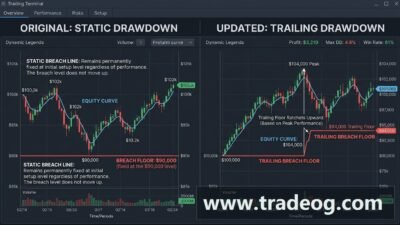
- Static Maximum Drawdown: The loss floor is permanently locked at a fixed cash level (e.g., $90,000 on a $100K account with a 10% limit). Profit earned increases your safety buffer.
- Trailing Maximum Drawdown: The loss floor trails upward as your account achieves new high-water marks in equity or balance. If a gold trade spikes your equity up by $3,000 and then reverses, a trailing floor may have moved up with it, permanently locking in a higher breach ceiling.
Gold’s large intraday swings make trailing drawdown accounts exceptionally dangerous. A temporary floating gain that retraces can pull your drawdown floor higher, leaving you with a compromised cushion when the trade closes.
Can an Open XAUUSD Trade Breach the Account?
Yes, under any prop firm utilizing an equity-based risk engine.
A trader does not need to close a gold trade to breach their account. If you hold an open position and the market moves against you—or if spreads widen—the live equity tick will drop. The moment that equity value touches the daily or maximum loss limit, automated risk daemons terminate the account and liquidate all open tickets.
XAUUSD Overnight Trading Rules
Before holding a gold position past the daily market close, verify these operational rules:
- Account Holding Permissions: Standard evaluation accounts frequently mandate that all positions be closed before daily market settlement. Dedicated “Swing” accounts generally permit overnight holding.
- Daily Session Break: Gold trading halts daily for 45 to 60 minutes around 5:00 PM New York time. During this break, orders cannot be closed, modified, or placed.
- Overnight Financing Charges (Swaps): Holding positions across 5:00 PM NY incurs swap debits. Understand how financing fees compound risk in our guide on XAUUSD swap fees.
Can You Hold XAUUSD Over the Weekend?
Holding gold over the weekend carries the highest degree of market risk in trading:
- Weekend News Shocks: Geopolitical conflicts, central bank emergency announcements, and macro shocks occur while markets are closed.
- Sunday Reopening Gaps: When trading resumes on Sunday afternoon, gold routinely opens $10 to $30 away from Friday’s closing price. If price gaps through your stop-loss, your trade fills at the opening market price, producing massive slippage.
- Firm Compliance Flags: Many prop firms explicitly prohibit weekend holding on intraday tiers. If an open trade is detected at the Friday close, the account is either flagged with a soft breach or disqualified automatically.
XAUUSD Trading Hours
Gold does not trade continuously. A typical CFD gold trading schedule follows these general boundaries (subject to broker platform timezone):
- Weekly Market Open: Sunday ~5:00 PM / 6:00 PM US Eastern Time.
- Daily Trading Break: Monday through Thursday, trading halts from 5:00 PM to 6:00 PM US Eastern Time for market clearing and settlement.
- Weekly Market Close: Friday 5:00 PM US Eastern Time.
- Holiday Schedules: Gold trading closes early on US holidays such as Thanksgiving, Christmas, New Year’s Day, and US Independence Day.
Always inspect the “Trading Hours” tab in your platform’s symbol properties to confirm exact opening and closing times.
XAUUSD During Low Liquidity
Low liquidity occurs predictably during session transitions, particularly between 4:55 PM and 5:30 PM New York time and during early Asian trading hours. In thin liquidity:
- Market depth evaporates, meaning large orders cannot be matched at resting prices.
- Spreads expand by several hundred percent.
- Stop-loss orders suffer severe adverse execution slippage.
For an exhaustive breakdown of thin-market mechanics, see low-liquidity trading.
XAUUSD Slippage Rules
Slippage is the difference between the price at which your stop-loss or market order was triggered and the price at which it actually filled on the server. In fast-moving gold markets, expected price does not equal guaranteed execution price.
Prop firms execute orders based on real or simulated market liquidity. When volatility spikes, your stop-loss set at $2,640.00 may execute at $2,634.50. That $5.50 difference per ounce represents pure slippage that expands your realized loss. Learn how prop firms evaluate execution discrepancies in our guide on stop-loss slippage.
XAUUSD Stop-Loss Rules
Stop-loss requirements vary across prop firms:
- Mandatory Stop-Loss Policies: Some firms require every open position to have a hard stop-loss entered within 2 to 5 minutes of execution. Failing to place a stop-loss is logged as an immediate rule violation.
- Discretionary Stop-Loss Policies: As documented by FTMO, stop-loss orders are not strictly mandatory, though they are strongly recommended as sound risk practice.
Even where stop-losses are not required by contract, trading gold without a hard stop on a prop firm account is mathematically reckless.
XAUUSD Prohibited Trading Strategies
While standard technical and discretionary trading on gold is universally permitted, prop firms actively ban abusive execution strategies:
- Latency Arbitrage: Exploiting pricing delays between the prop firm’s feed and fast institutional liquidity feeds.
- High-Frequency Tick Scalping: Opening and closing massive gold positions within 2 to 5 seconds to exploit platform pricing mechanics. (For example, The5ers explicitly restricts ultra-short-duration HFT where trades last only seconds).
- News Bracketing / Straddling: Placing opposite Buy Stop and Sell Stop orders seconds before Tier-1 news releases to game the initial volatility spike.
- Account Sharing & Public Copy Trading: Using automated signals shared across hundreds of challenge accounts simultaneously.
Can You Scalp XAUUSD With a Prop Firm?
Yes, scalping gold is widely practiced, but you must ensure your strategy complies with specific operational rules:
- Minimum Trade Duration: Check whether your firm enforces a minimum holding period (e.g., trades must be open for at least 1 to 2 minutes).
- Spread Friction: Ensure your average profit target (e.g., $1.50) is not disproportionately consumed by a $0.30 spread and commission.
- Execution Latency: Scalping during fast markets requires high-quality server bridges to prevent entry slippage.
XAUUSD Position Size and Risk Calculation
Never size gold positions based on gut feel or arbitrary lot sizes. Use this mathematical framework to calculate exact lot exposure based on your daily drawdown buffer:
Position Size (Lots) = Planned Dollar Risk ÷ (Stop Distance in Dollars × Contract Multiplier)
Worked Example:
- Account Size: $100,000 | Daily Loss Limit: $5,000
- Planned Risk Allocation: $1,000 (1% of account)
- Gold Entry: $2,650.00 | Planned Stop Loss: $2,642.00
- Stop Distance: $2,650.00 − $2,642.00 = $8.00 per ounce
- Standard Contract Multiplier: 100 oz per lot
- Risk Per Lot: $8.00 × 100 oz = $800 per standard lot
- Calculated Position Size: $1,000 ÷ $800 = 1.25 Standard Lots
Sizing your trade to 1.25 lots guarantees that if your stop is hit, your monetary loss remains precisely at your intended $1,000 target (plus minor execution costs), keeping your daily drawdown fully protected.
XAUUSD Swap and Overnight Costs
Overnight financing fees (swaps) represent the interest differential charged or credited when holding leveraged contracts past 5:00 PM New York. On gold, retail CFD brokers frequently charge negative swaps on both long and short positions.
Furthermore, global interbank settlement conventions enforce Triple Swap Wednesday. On Wednesday evening at 5:00 PM NY, positions rolled overnight are charged three days of swap fees to account for weekend settlement. A swing position carried through Wednesday rollover incurs significant financing friction that directly reduces account equity.
XAUUSD Trading Day and Reset Time
Understanding when your prop firm’s trading day begins and ends is critical when managing running gold trades. Many traders incorrectly assume the trading day resets at their local midnight.
If your firm resets its daily loss calculation at 00:00 CE(S)T (as documented by FTMO), that reset occurs at 3:30 AM or 4:30 AM Indian Standard Time (IST), or 6:00 PM Eastern Time. Entering a new gold trade after your local midnight means you are still operating under yesterday’s daily loss buffer on the firm’s server. Verify your exact schedule using our dedicated guide on prop firm trading day reset.
XAUUSD Rules Checklist Before Your First Trade
Print or save this comprehensive pre-trade verification checklist:
1. Account Rules
- [ ] What is the exact daily loss percentage and starting equity baseline?
- [ ] Is maximum drawdown static or trailing?
- [ ] Does the firm track live equity ticks or closed balance?
- [ ] What exact server time does the daily loss counter reset?
2. Gold Specifications
- [ ] Is XAUUSD enabled for trading on your account tier?
- [ ] What is the active leverage for gold (e.g., 1:50 or 1:25)?
- [ ] What is the contract size (typically 100 oz)?
- [ ] What is the average daytime spread versus off-peak spread?
- [ ] What is the commission rate per standard lot?
3. Event & News Restrictions
- [ ] Are there high-impact news restrictions on gold for your account?
- [ ] What is the restricted window (e.g., ±2 minutes)?
- [ ] Do news restrictions apply to pending orders and stop-loss fills?
4. Holding & Session Rules
- [ ] Are positions permitted to be held overnight past 5:00 PM NY?
- [ ] Are positions permitted to be held across the weekend?
- [ ] What are the exact hours of the daily session halt?
5. Strategy Compliance
- [ ] Does your scalping strategy satisfy minimum trade duration rules?
- [ ] Are automated EAs permitted on gold?
- [ ] Are latency arbitrage and news straddling strictly avoided?
A Realistic XAUUSD Pre-Trade Decision Example
Observe how a disciplined funded trader analyzes an active setup on a $100,000 account:
Pre-Trade Decision Workflow
Account Status: $100,000 Size | Daily Loss Limit: $5,000 | Current Day’s Losses: -$1,200 | Remaining Daily Buffer: $3,800
Market Context: Technical bullish breakout on 15M gold chart at $2,650.00. US CPI announcement scheduled in 20 minutes.
- Check News Restrictions: The trader consults their firm’s rules. The account is a funded tier that prohibits opening/closing gold trades within 2 minutes of CPI. Because CPI is 20 minutes away, a quick scalp is technically permitted, but holding through CPI is prohibited.
- Check Current Live Spread: The trader inspects Market Watch. Gold spread has already expanded from $0.20 to $0.65 as liquidity providers pull depth ahead of CPI.
- Evaluate Execution Friction: The widened spread increases transaction costs threefold. Entering now increases entry slippage risk.
- Evaluate Time Horizon: A trade entered now must be closed in 18 minutes to comply with the 2-minute pre-news window, forcing an unnatural exit.
- Trade Decision: STAND DOWN. The disciplined trader elects not to trade. They wait for CPI to release, allow post-news spreads to normalize, and re-evaluate the setup under liquid market conditions.
14 Common Mistakes XAUUSD Prop Traders Make
- Assuming All Prop Firms Share the Same Gold Rules: Expecting Firm B to follow Firm A’s leverage and news policies.
- Trading With Outdated Leverage Data: Relying on old forum threads rather than checking current contract specifications.
- Holding Trades Through Restricted News Windows: Forgetting that news rules on gold can disqualify funded accounts.
- Monitoring Terminal Balance Instead of Live Equity: Watching closed cash while floating equity approaches the daily loss floor.
- Ignoring Rollover Spread Blowouts: Holding open positions through 5:00 PM NY with tight stops.
- Neglecting Commission Deductions: Failing to realize percentage-based commissions reduce drawdown buffers instantly.
- Assuming Pending Orders Are Exempt From News Rules: Leaving Buy Stops active that trigger during high-impact releases.
- Copying Another Trader’s Lot Sizing: Using someone else’s lot size without calculating contract multipliers and stop distances.
- Ignoring Trailing Drawdown High-Water Marks: Allowing large floating profits to retrace on trailing accounts.
- Failing to Audit Platform Symbol Specifications: Neglecting to verify whether contract size is 100 oz or 10 oz.
- Confusing Platform Server Clock with Local Time: Miscalculating the daily drawdown reset hour.
- Trading Gold During Off-Peak Sessions: Scalping during thin Asian hours when spreads consume profit targets.
- Failing to Set Calendar Alerts for US Daylight Saving Time: Forgetting that US clock shifts alter trading hours and news release times.
- Attempting Latency Arbitrage on Gold: Deploying toxic algorithmic flow that triggers immediate compliance bans.
How to Check Your Prop Firm’s Current XAUUSD Rules
Follow this 7-step procedure to extract accurate, verified gold trading conditions:
- Open the Official Trading Rules Portal: Navigate to your prop firm’s official website and access the legal agreement or Knowledge Base.
- Search Specific Keywords: Search for “XAUUSD,” “Gold,” “Metals Leverage,” “News Window,” and “Trading Hours.”
- Inspect Platform Symbol Specification: In MT4, MT5, or cTrader, right-click XAUUSD and open “Specification.” Review contract size, margin percentage, minimum volume, and swap rates.
- Log In to the Account Dashboard: Check the live risk metrics panel for real-time daily drawdown tracking.
- Review the Official Macro News Calendar: Identify which economic events are flagged as restricted by the firm’s compliance engine.
- Submit a Written Support Ticket: If rules around overnight holding or news execution are ambiguous, ask customer support for written clarification.
- Archive the Documentation: Save a screenshot or PDF of the current rulebook with a date stamp for your records.
Why Old Prop-Firm Articles Can Be Misleading
Proprietary trading firms operate in a dynamic regulatory and commercial environment. Broker partnerships, liquidity providers, and risk policies change frequently.
For example, in February 2026, FTMO officially updated its leverage parameters on XAU pairs across its account tiers. A trader reading an article or watching a YouTube video published in 2024 would believe gold leverage was set to 1:100, whereas current rules enforce 1:50 or 1:15 depending on account type. Relying on outdated third-party reviews can lead to margin miscalculations, improper position sizing, and catastrophic account breaches.
Frequently Asked Questions
Can I trade XAUUSD with a prop firm?
Yes. The vast majority of prop firms offer XAUUSD (Gold) as a tradable CFD or futures contract, though leverage, commissions, and news rules differ between firms.
Is gold allowed in prop-firm challenges?
Yes, gold is widely permitted during evaluation challenges and funded stages, provided the trader adheres to general risk limits and platform rules.
Are there special XAUUSD news rules?
Yes. Because gold reacts aggressively to US macroeconomic data, many firms restrict opening, closing, or triggering orders on XAUUSD within a 2-minute to 5-minute window around high-impact releases.
Can I trade gold during CPI?
This depends on your firm and account tier. Some firms allow news trading in full, while others (like FTMO on standard funded accounts) restrict gold execution during CPI releases.
Can I trade XAUUSD during NFP?
Non-Farm Payrolls is a Tier-1 news event. If your prop firm enforces news trading restrictions, gold trading is almost universally restricted during the release window.
Can I hold XAUUSD overnight?
Most dedicated swing accounts permit overnight holding, while standard intraday evaluation accounts often require closing positions prior to the daily 5:00 PM NY session break.
Can I hold XAUUSD over the weekend?
Only if your specific account tier explicitly allows weekend holding. Carrying gold over the weekend exposes accounts to Sunday opening price gaps.
What leverage is available for XAUUSD?
Gold leverage is typically lower than forex leverage. For example, FTMO enforces 1:50 on Standard Accounts and 1:15 on Swing Accounts, while The5ers provides 1:25 on High Stakes accounts.
Does spread affect prop-firm drawdown?
Yes. An expanding spread immediately reduces the mark-to-market floating P/L of open positions, which directly contracts account equity and remaining daily drawdown.
Can gold spread widening trigger a breach?
Yes. If you hold an open position near your daily loss floor, a rollover spread blowout can depress equity past the breach threshold without directional price movement.
Can I scalp XAUUSD?
Yes, provided your scalping strategy complies with minimum trade duration rules and does not utilize prohibited high-frequency tick arbitrage.
Are EAs allowed for gold?
Most prop firms permit Expert Advisors (EAs) for gold trading, provided the EA does not execute prohibited strategies like latency arbitrage, account sharing, or news straddling.
Is XAUUSD news trading allowed?
News trading policies vary. Verify whether your account tier permits news trading, and check whether restrictions apply to existing positions versus new orders.
Does XAUUSD have different commissions?
Yes. Some firms charge standard flat fees per lot, while others (such as The5ers) apply percentage-based commissions on the notional value of precious metals.
Does the daily drawdown reset at midnight?
It resets at midnight in the firm’s designated timezone (e.g., 00:00 CE(S)T for FTMO), which rarely matches local midnight in your home country.
Where can I find my firm’s exact gold rules?
Review the official terms of service on the firm’s website, check the symbol specification inside your trading platform, and monitor live metrics on your client dashboard.
[…] If you find yourself in a running gold trade that is moving unfavourably during CPI, manually clicking “Close Position” inside the restricted window generates an order close ticket that is timestamped inside the prohibited period. If your firm restricts order closing, you cannot legally exit the trade until the window expires. For comprehensive pre-trade rules, consult our guide on XAUUSD prop-firm rules. […]