

A prop firm’s trading day does not necessarily reset at your local midnight. The reset time is determined by the firm’s rules and the timezone used for its daily loss or drawdown calculation. Some firms use a specific company timezone, while platform server time may display something different. Always check the firm’s official rules or dashboard before assuming when the new trading day begins.
Quick Answer: When Does a Prop Firm Trading Day Reset?
For Indian traders, see our India-specific daily drawdown reset guide for IST conversions and seasonal timing.
There is no universal, industry-wide reset time across proprietary trading firms. Each firm defines its own trading-day boundary based on its operating timezone, platform architecture, and risk management engine.
Key operational realities every trader must understand include:
- Individual Firm Policies: Each prop firm establishes its own specific reset schedule. One firm may reset at European midnight, another at US market close, and another on pure UTC.
- Risk Engine vs Platform Display: The clock shown on your MetaTrader 4, MetaTrader 5, or cTrader terminal may display a different time zone than the one used by the firm’s risk engine to calculate your daily loss.
- Daylight Saving Shifts: Seasonal Daylight Saving Time (DST) changes in the United States and Europe alter the time difference between your local clock and the firm’s reset schedule twice every year.
- Dashboard as Final Reference: The countdown timer and metric values shown on your official prop firm account dashboard represent the ultimate benchmark for risk enforcement, superseding any assumptions based on your local clock.
What Is a Prop Firm Trading Day?
In standard civilian life, a day begins at 12:00 AM and ends at 11:59 PM in your geographic location. In proprietary trading, a “trading day” is an artificial risk-management window defined by a legal contract and automated by server software.
To navigate prop trading rules successfully, distinguish between these related concepts:
- Calendar Day: A 24-hour period from local midnight to midnight in your home country.
- Trading Session: The active hours of a specific regional market, such as the London Session (08:00–16:30 GMT) or the New York Session (09:30–16:00 EST).
- Market Day: The global financial day, which in the forex market conventionally concludes at 5:00 PM New York time when interbank trades settle and overnight swaps are applied.
- Risk Day / Calculation Period: The specific 24-hour cycle established by the prop firm during which your cumulative daily losses cannot exceed a predefined threshold (typically 4% or 5%).
When prop firms enforce a Maximum Daily Loss, they monitor performance across their official Risk Day, regardless of what session you are trading or what date appears on your local wall calendar.
What Time Does the Daily Drawdown Reset?
The exact hour of your daily drawdown reset depends entirely on the firm’s technical infrastructure and stated terms of service. Most proprietary trading firms fall into one of several primary reset models:
- European Midnight (00:00 CE(S)T): Widely used by continental European firms. The daily calculation refreshes at midnight in Central Europe.
- New York Market Close (17:00 EST/EDT): Popular among firms aligning directly with interbank forex settlement and rollover.
- Platform Server Midnight (00:00 Server Time): Calculated when the digital clock on the MT4/MT5 “Market Watch” panel turns 00:00 (frequently configured as GMT+2 or GMT+3).
- Universal Time Midnight (00:00 UTC): A fixed standard that eliminates daylight saving confusion.
As a prominent, clearly documented example, FTMO states in its official Trading Objectives that its Maximum Daily Loss is recalculated precisely at 00:00 CE(S)T (Prague time). FTMO’s documentation specifies that the daily loss baseline is set using the account balance (or equity, whichever is higher) recorded at that exact timestamp. However, this is an FTMO-specific specification and must not be assumed as the standard for every other firm.
Does Every Prop Firm Reset at Midnight?
No. Assuming that every prop firm resets at midnight is one of the most expensive assumptions a challenge trader can make.
Even among firms that advertise a “midnight reset,” that midnight refers to the firm’s chosen timezone—not yours. Furthermore, market sectors operate under distinct structural schedules:
- CFD and Forex Accounts: Tend to cluster around European midnight (CE(S)T) or New York 5:00 PM rollover.
- Futures Prop Accounts: Operate under exchange-regulated trading sessions. In futures trading, the clearing day is governed by exchange settlement windows. For example, FTMO Futures documents an official daily market close at 4:10 PM US Eastern Time, creating an entirely different session schedule compared to CFD products.
Trading different account types within the same firm can mean managing completely different reset schedules.
Prop Firm Reset Time vs Server Time
Traders frequently conflate the time displayed on their charting terminal with the time their daily risk allowance resets. These parameters often diverge:
| Time Reference | Definition | Operational Role |
|---|---|---|
| Local Time | The current time in your physical location. | Governs your sleep schedule and trading sessions. Ignored by risk servers. |
| Server Time | The clock displayed by your MT4, MT5, or cTrader platform. | Timestamps order fills, candle closes, and trade execution tickets. |
| Firm Timezone | The legal operational timezone named in the prop firm’s rules. | Defines business hours, support availability, and official deadlines. |
| Risk Reset Time | The exact moment the daily drawdown baseline is recalculated. | Determines whether yesterday’s losses still restrict today’s trading. |
| Market Session Time | The opening and closing schedule of specific asset classes. | Governs trading halts, weekend gaps, and interbank liquidity. |
For an exhaustive breakdown of how server architecture interacts with daily drawdown math, read our detailed guide on prop firm server time.
What Time Does a Prop Firm Trading Day Reset in India?
Indian Standard Time (IST) is UTC+5:30. India does not observe Daylight Saving Time, which means the offset between an Indian trader’s clock and a foreign prop firm’s server shifts twice a year.
Indian traders should never assume a permanent static reset time. Instead, evaluate the following six variables:
- The Firm’s Base Timezone: Is the firm based in the UK (GMT/BST), Europe (CET/CEST), or the United States (EST/EDT)?
- The Current Season (DST Status): Has North America or Europe shifted its clocks forward or backward?
- The Mathematical Offset:
- When a firm resets at 00:00 CET (European winter), the reset occurs at 4:30 AM IST.
- When that same firm switches to 00:00 CEST (European summer), the reset shifts to 3:30 AM IST.
- When a US-based firm resets at 5:00 PM EST (US winter), the reset occurs at 3:30 AM IST.
- When that US firm switches to 5:00 PM EDT (US summer), the reset shifts to 2:30 AM IST.
- Platform Server Time: Confirm whether your MT5 Market Watch clock matches the firm’s calculation timezone.
- Dashboard Verification: Cross-check the countdown timer on your official client dashboard.
- Account Specifications: Confirm whether swing accounts or evaluation tiers use alternative reset rules.
Why Daylight Saving Time Can Change the Reset Time
Daylight Saving Time (DST) causes substantial confusion because global jurisdictions adjust their clocks on different dates:
- United States: Advances clocks on the second Sunday in March and falls back on the first Sunday in November.
- European Union & UK: Advances clocks on the last Sunday in March and falls back on the last Sunday in October.
- India, Singapore, UAE: Maintain static UTC offsets year-round.
During the “gap weeks” in March and October/November, European and American clocks fall out of their normal sync for two to three weeks. In its official 2026 operational updates, FTMO explicitly highlighted to traders that while its Maximum Daily Loss is monitored in Prague time (CE(S)T), daylight saving shifts change the relationship between Prague time and MetaTrader server time. When platform server clocks adjust while national borders adjust separately, traders who do not track these transitions risk executing trades under outdated reset assumptions.
Can You Breach Daily Drawdown Before the Reset?
Yes. The daily loss limit remains in active enforcement up to the final millisecond before the scheduled reset.
Consider this realistic risk management scenario:
Scenario: The Premature New-Day Entry
- Account Starting Balance: $100,000
- Maximum Daily Loss Limit (5%): $5,000 (Daily Floor: $95,000)
- Current Intraday Losses: -$4,200
- Current Account Equity: $95,800 ($800 above the breach line)
- Trader’s Local Time: 12:30 AM (Thursday morning)
- Prop Firm Reset Time: 4:30 AM (Thursday morning — 4 hours away)
The trader observes that their local calendar has advanced to Thursday. Believing they now have a fresh $5,000 allowance, they enter a new trade risking $1,000. Price moves against them, and the position is stopped out for -$1,000 at 1:15 AM.
Because the firm’s reset has not occurred, the automated risk engine records a cumulative daily loss of -$4,200 + -$1,000 = -$5,200. The account is instantly terminated. The trader possessed sufficient skill to manage risk; they simply misjudged the clock.
What Happens to an Open Trade at the Reset?
Passing the daily reset time does not close your positions, cancel your orders, or reset your trade history. An open trade continues to run in real time.
However, the way the firm calculates your risk across the reset boundary is critical:
- Position Continuity: The trade remains active in the market, subject to ongoing floating gains or losses.
- Equity Baseline Recalculation: Most major prop firms (such as FTMO) recalculate the new day’s baseline based on your recorded balance or equity at the exact moment of the reset.
- Floating P/L Exposure: If your open position is floating at a -$1,500 loss at 23:59:59 and remains open at 00:00:01, that floating loss is factored into the new day’s baseline according to the firm’s equity tracking rules.
- Overnight Restrictions: If your account type prohibits overnight holding, failing to close the position before the official market close triggers an automatic rule violation.
For a detailed analysis of how open positions interact with risk engines, read our guide on open trades and prop firm drawdown.
Does the Daily Loss Limit Reset Even If I Have an Open Position?
Yes, the daily limit calculation resets—but your floating loss does not disappear.
Traders must separate two completely distinct concepts:
- Resetting the Daily Limit Calculation: The risk engine archives the previous day’s tally and establishes a new numerical loss ceiling for the incoming 24-hour cycle.
- Resetting a Trade’s Floating P/L: An open position’s unrealized profit or loss never “resets” to zero. If you are down -$2,000 on a running position, that -$2,000 remains active on your account ledger.
If your prop firm enforces an equity-based daily drawdown, carrying a deeply negative position across the reset means your new day begins with a compromised equity cushion. Read our comprehensive breakdown on equity vs balance to see how live equity changes affect account survival.
Example of a Trading-Day Reset
To visualize the reset mechanics, observe this hypothetical worked example of an account transitioning across the boundary. (Note: This is an illustrative example; individual firm calculations vary.)
Hypothetical Account Progression
Account Setup: $100,000 Initial Size | 5% Daily Loss Limit ($5,000) | Firm Reset at 00:00 CE(S)T | Trader Location: Mumbai (IST)
Phase 1: Before Reset (3:00 AM IST / 22:30 Server Time)
- Closed Balance: $101,500 (profitable previous trades)
- Open Trade Floating P/L: -$1,200
- Current Account Equity: $100,300
- Day’s Permitted Daily Floor: $96,425 (based on Day 1 start)
- Status: Safe. Equity is well above the daily limit.
Phase 2: At Reset (3:30 AM IST / 00:00:00 Server Time)
- The firm’s risk engine takes a snapshot.
- Under an equity-monitoring model that benchmarks against current balance or equity, the firm records: Balance = $101,500, Equity = $100,300.
- Day 1 is formally archived. Day 2 begins.
Phase 3: After Reset (4:00 AM IST / 00:30 Server Time)
- The firm establishes the Day 2 Maximum Daily Loss limit based on its formula (e.g., 5% of starting balance = $5,075 max loss, creating a new Day 2 floor of $96,425).
- The open position is still active at -$1,200.
- The trader now operates under the Day 2 parameters, not their local Indian calendar.
What Happens If You Confuse the Reset Time?
Misinterpreting the daily reset window causes distinct operational errors:
- Premature Risk-Taking: Entering fresh trades after local midnight while previous losses are still active on the server.
- Overleveraging Straddled Trades: Adding to open positions immediately before the reset, unaware that high spreads during rollover will inflate floating losses.
- Misreading Account Dashboards: Believing a dashboard is broken when it fails to show a zeroed loss bar at local midnight.
- Accidental Daily Limit Breaches: Stacking losses from two separate local days into a single server trading day.
How to Find Your Prop Firm’s Exact Reset Time
Execute this 7-step verification procedure for every new prop firm account:
- Consult Official Terms of Service: Search the contract or FAQ specifically for “Maximum Daily Loss calculation” and “Trading Day definition.”
- Identify the Named Timezone: Note whether the document specifies CE(S)T, UTC, EST, or Server Time.
- Check the Client Portal Dashboard: Log in to your metrics portal and locate the live daily loss countdown timer.
- Audit the Trading Platform Clock: Open your MT4/MT5 terminal and note the digital time displayed at the top of Market Watch.
- Cross-Reference DST Calendars: Determine whether the firm’s host country is currently observing standard or summer daylight time.
- Calculate Your Personal Local Offset: Subtract your local time from the confirmed reset time to establish your personal reset hour.
- Verify Account Tier Differences: Confirm whether swing accounts, algorithmic accounts, or scaling tiers operate on distinct timing rules.
Where Should Traders Check the Reset Time?
To avoid conflicting information, verify your reset time using this ordered hierarchy of reliability:
- Official Account Dashboard (Highest Reliability): Live countdown timers reflect the actual automated risk engine.
- Current Official Trading Rules: The legal contract governing evaluation and payout compliance.
- Official Knowledge Base / FAQ: Up-to-date explanations written by the firm’s compliance desk.
- Written Support Confirmation: Direct confirmation from support tickets (save a screenshot of the response).
- Platform Server Clock: Helpful for tracking tick timestamps, but does not always reflect risk engine logic.
- Forums, Discord, and YouTube (Lowest Reliability): Frequently outdated, inaccurate, or based on previous rule versions.
10 Common Mistakes Traders Make With Reset Times
- Assuming Local Midnight Resets the Day: Trading at 12:05 AM in your home timezone under an unrefreshed limit.
- Confusing Platform Server Time with Risk Time: Believing the MT5 clock is the sole authority when the dashboard uses another timezone.
- Ignoring Biannual Daylight Saving Shifts: Forgetting that local reset hours change by 60 minutes in spring and autumn.
- Relying on Outdated Information: Trusting YouTube guides recorded under previous contract versions.
- Assuming Universal Rules Across Firms: Expecting Firm B to follow Firm A’s European midnight schedule.
- Carrying Large Floating Losses Across Reset: Failing to recognize that open drawdown impairs the new day’s equity buffer.
- Ignoring Balance vs Equity Distinctions: Watching cash balance while equity hovers fractions of a percent above breach.
- Trusting Social Media Advice: Taking timing tips from traders operating in different countries.
- Applying Fixed Static Offsets: Using a hardcoded UTC conversion that fails during DST transition weeks.
- Neglecting Rollover Spread Spikes: Placing orders during the reset window when widened spreads trigger premature stop-outs.
Prop Firm Reset Time vs Forex Market Reset
The forex market reset and your prop firm’s daily loss reset are fundamentally different mechanisms:
- Forex Market Rollover: Occurs universally at 5:00 PM New York time. At this moment, interbank liquidity thins, trading sessions roll to the next date, and overnight swap fees are debited or credited.
- Prop Firm Daily Drawdown Reset: The specific administrative moment when the firm’s database closes Day A’s performance ledger and establishes Day B’s baseline.
If your prop firm resets at 00:00 CE(S)T, its daily loss reset occurs several hours before the New York 5:00 PM rollover. Consequently, your account experiences two distinct adjustments: your daily drawdown limit refreshes first, and overnight swap charges hit hours later. To learn how financing charges impact risk calculations, read our guides on swap fees and drawdown and commissions and prop firm drawdown.
Prop Firm Reset Time vs MT4/MT5 Server Time
A helpful way to visualize how time flows through your trading setup is the three-tier clock hierarchy:
Your Local Time → Platform Server Time → Firm Risk Calculation Time
Most retail brokerages configure MT4 and MT5 servers to GMT+2 (winter) / GMT+3 (summer) to align five 24-hour daily candles per week with the New York close. However, the prop firm’s risk engine may evaluate compliance on an independent web server running on CE(S)T or UTC.
During that transition window, liquidity providers frequently widen bid-ask spreads substantially. Learn how sudden spread blowout impacts open trades in our analysis on spread expansion.
Prop Firm Reset Time and XAU/USD (Gold) Trading
Gold traders face acute vulnerability around the daily reset window due to the instrument’s unique microstructure:
- Extreme Pip Value: Because a 100-pip move on gold represents substantial dollar exposure even on modest lot sizes, carrying open positions across the reset creates severe volatility risk.
- Session Rollover Spreads: Gold spreads routinely expand from 15–20 cents to $1.50–$3.00 during the 5:00 PM New York session transition.
- Compounded Floating Losses: A gold trader down -$3,500 who holds an open 3-lot position through the reset can see their floating loss instantly spike to -$4,800 purely from spread blowout, threatening a breach before the new trading day establishes liquid pricing.
Gold traders should also review how volatile execution affects account standing in our guide on slippage during high-impact news.
Does the Reset Give Traders a “Fresh Account”?
No. A daily reset refreshes only the daily loss limit calculation. It does not erase your accumulated trading history.
The daily reset does NOT:
- Erase your overall maximum drawdown tally
- Restore lost cash balance
- Eliminate open floating losses
- Wipe away soft breach warnings or compliance flags
If you began a $100,000 challenge with a $10,000 maximum loss limit and have lost $6,000 cumulatively over three days, the daily reset merely allows you to trade tomorrow without breaching your daily rule. Your account remains at $94,000, leaving only $4,000 of lifetime cushion before a permanent maximum drawdown breach occurs.
Daily Drawdown Reset vs Maximum Drawdown
Understanding how the daily reset interacts with total account limits is summarized below:
| Rule Type | Recalculated Daily? | Operational Function |
|---|---|---|
| Maximum Daily Loss | Yes (at official reset time) | Restricts maximum permissible equity decline within a single 24-hour cycle. |
| Maximum Overall Loss | No (continuous lifecycle limit) | Fixed or static boundary below which the account can never fall. |
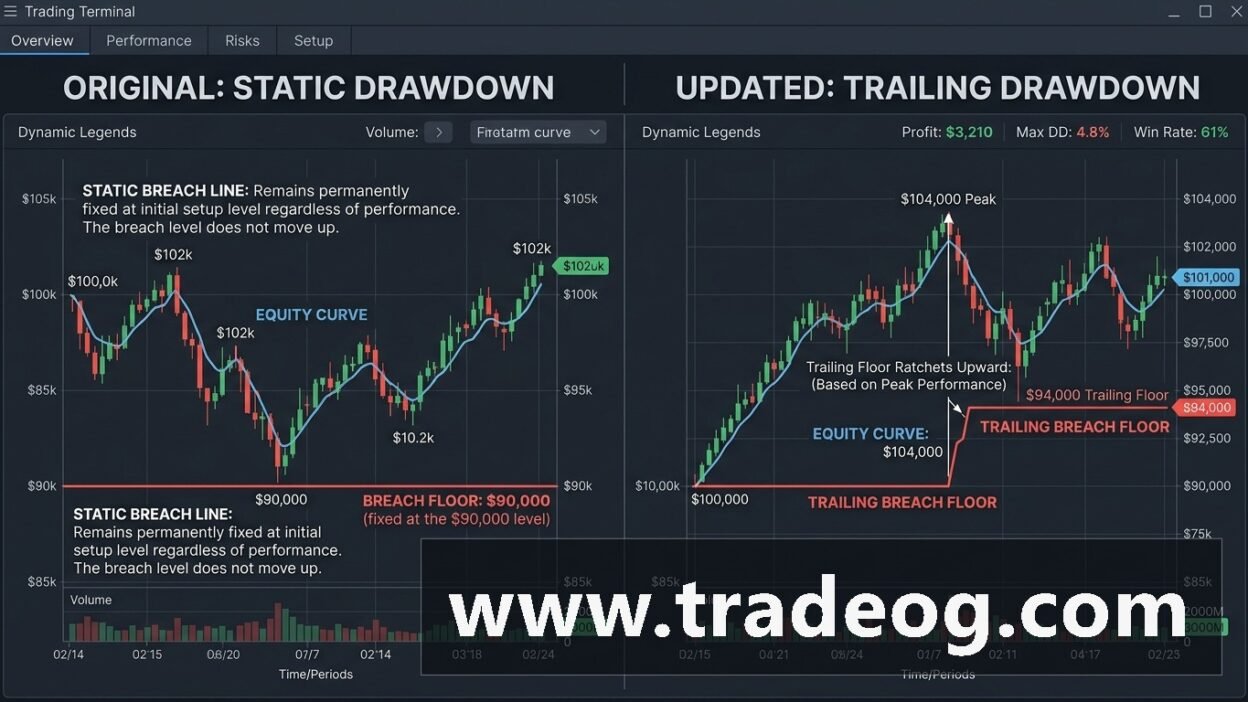
| Trailing Drawdown | Dynamic (moves with high water mark) | Trails peak equity or balance upward, locking in a ratcheting floor. |
| Profit Target | No (cumulative milestone) | Total percentage gain required to advance to the next challenge phase. |
Always verify the exact mathematical formulas documented in your specific prop firm’s official agreement.
How to Calculate Your Reset Time in IST
To convert any prop firm’s stated reset time into Indian Standard Time, apply this universal conversion formula:
Firm Reset Time (in UTC) + 5 Hours and 30 Minutes = Local Reset Time (IST)
Worked Conversion Example:
- The firm documents a reset at 00:00 Central European Summer Time (CEST).
- Identify the current UTC offset for CEST: CEST = UTC+2.
- Convert the reset time to UTC: 00:00 CEST minus 2 hours = 22:00 UTC (previous evening).
- Add the IST offset (+5:30): 22:00 UTC + 5 hours 30 minutes = 3:30 AM IST.
- Result: The daily drawdown resets at precisely 3:30 AM Indian Standard Time.
Remember that when Europe switches back to Central European Time (CET = UTC+1) in late October, the exact same calculation yields 4:30 AM IST.
Questions to Ask Your Prop Firm About Reset Times
Submit these questions to your prop firm’s support desk to obtain unambiguous written guidance:
- What exact timezone dictates the start and end of your official trading day?
- At what precise time does the Maximum Daily Loss calculation reset?
- Does the daily loss reset rely on platform server time or client dashboard time?
- How does your reset schedule adjust for US and European Daylight Saving Time?
- Is the new day’s loss threshold benchmarked against starting balance or starting equity?
- How is the daily limit calculated if an open position is carried across the reset boundary?
- Are overnight swap deductions credited to the outgoing or incoming trading day?
- Does your daily reset time differ between challenge stages and funded accounts?
- Does your platform enforce a mandatory trading halt during the daily reset window?
- Where can I locate the live countdown timer showing remaining time in the active trading day?
- If an execution discrepancy occurs during the reset, what platform logs are required to submit an inquiry?
Frequently Asked Questions
What time does a prop firm trading day reset?
There is no universal reset time. Depending on the firm, the trading day commonly resets at 00:00 CE(S)T (European midnight), 00:00 UTC, 00:00 Server Time (GMT+2/GMT+3), or 17:00 New York time. Always check your firm’s specific documentation.
Does every prop firm reset at midnight?
No. Some firms reset at the 5:00 PM New York market close, and futures prop firms often align with exchange session settlements (such as 4:10 PM US Eastern Time). Even firms that reset at midnight do so in their designated timezone, which rarely matches your local midnight.
What time does prop firm daily drawdown reset?
Daily drawdown resets at the exact instant the firm’s official risk day rolls over. For European-based firms, this frequently occurs at 00:00 CE(S)T; for US-focused firms, it often coincides with the 5:00 PM EST session close.
Does the reset happen at midnight IST?
No. Unless a prop firm explicitly operates on Indian Standard Time, resets for Indian traders typically occur in the early morning hours—commonly between 2:30 AM and 4:30 AM IST depending on the firm’s host country and daylight saving status.
Is prop firm server time the same as reset time?
Not always. A firm may host its MetaTrader servers on GMT+2/GMT+3 to optimize daily candlestick charts while calculating risk compliance on a web server running on UTC or CE(S)T. The dashboard countdown timer is the ultimate reference.
Can an open trade affect the next trading day?
Yes. Open positions remain live across the reset, and their unrealized floating profit or loss will be factored into the new day’s baseline equity calculation according to the firm’s daily loss methodology.
Does the daily loss limit reset after midnight?
It resets after midnight in the firm’s designated timezone, which may be hours before or after midnight in your home country.
Does daylight saving change prop firm reset time?
Yes. If your prop firm’s host country observes Daylight Saving Time while your country does not (such as India or the UAE), the local time of your daily reset will shift by one hour twice a year.
How do I check my prop firm’s reset time?
Log in to your client dashboard to view the live daily loss countdown timer, review the firm’s official Trading Objectives FAQ, or contact official support for written confirmation.
What happens if I trade through the reset?
Orders executed immediately across the reset boundary face elevated risk from rollover spread expansion and interbank liquidity gaps. Furthermore, trades closed seconds before or after the boundary will be logged on different trading days.
Does daily reset remove my previous loss?
No. The reset refreshes your daily allowance for the new 24-hour cycle, but previous losses remain permanently deducted from your account balance and lifetime maximum drawdown limit.
Is the prop firm reset time the same as the forex market reset?
Not necessarily. The global forex market rollover universally occurs at 5:00 PM New York time, whereas prop firm risk engines may reset at European midnight (00:00 CE(S)T), platform midnight, or UTC.

[…] with depressed equity can jeopardize your newly allocated daily buffer. Check our detailed guide on prop firm trading day reset and review the infrastructure mechanics in prop firm server […]
[…] As explicitly documented by The5ers, news restriction windows are audited against the platform server clock, not your local computer clock. Furthermore, because the US and Europe transition to Daylight Saving Time on different calendar dates in March and October/November, the hour difference between US CPI releases and broker server times shifts twice a year. Verify your platform’s exact clock using our guide on prop firm server time and check your daily rollover timing in prop firm trading-day reset. […]
[…] If your firm resets its daily loss calculation at 00:00 CE(S)T (as documented by FTMO), that reset occurs at 3:30 AM or 4:30 AM Indian Standard Time (IST), or 6:00 PM Eastern Time. Entering a new gold trade after your local midnight means you are still operating under yesterday’s daily loss buffer on the firm’s server. Verify your exact schedule using our dedicated guide on prop firm trading day reset. […]