

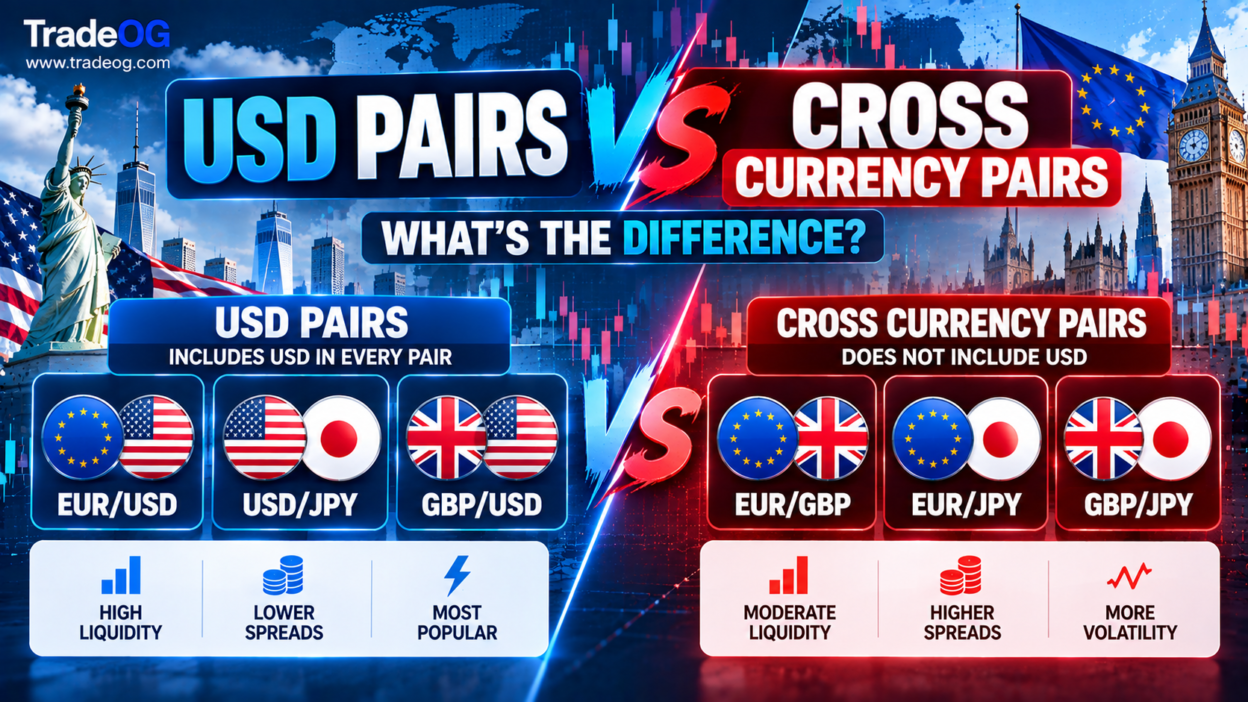
When forex traders compare USD pairs vs cross currency pairs, the main difference is simple: a USD pair contains the US dollar, while a cross currency pair does not. But that small structural difference can change what drives the price, how traders interpret economic news, how liquidity behaves and which trading sessions may be most useful.
For example, EUR/USD is a USD pair, while EUR/GBP is a cross. USD/JPY is a USD pair, while GBP/JPY is a cross. Both categories can offer excellent trading opportunities, but they expose traders to different combinations of economic and monetary-policy risks.
This guide explains the difference in practical terms, including liquidity, spreads, volatility, news drivers, synthetic pricing, trading sessions, scalping, swing trading and what Indian forex traders should consider before choosing between the two.
USD Pairs vs Cross Currency Pairs: Quick Comparison
| Feature | USD Pairs | Cross Currency Pairs |
|---|---|---|
| US dollar included? | Yes | No |
| Examples | EUR/USD, USD/JPY, GBP/USD | EUR/GBP, EUR/JPY, GBP/JPY |
| Main pricing influence | USD versus another currency | One non-USD currency versus another |
| Liquidity | Often very high in major USD pairs | Varies by cross |
| Spreads | Often tighter in major pairs | Can be wider |
| Key macro drivers | US policy plus the other currency’s economy | Relative policy and economic outlook of both non-USD currencies |
| Beginner accessibility | Usually easier | Requires understanding two non-USD economies |
These are general market tendencies rather than guarantees. A highly traded cross such as EUR/JPY can have substantial liquidity, while a less-traded USD pair involving an emerging-market currency can have wider spreads.
What Is a USD Currency Pair?
A USD currency pair is any forex pair in which the US dollar appears on one side of the quote.
Examples include:
- EUR/USD — euro versus US dollar
- USD/JPY — US dollar versus Japanese yen
- GBP/USD — British pound versus US dollar
- USD/CHF — US dollar versus Swiss franc
- AUD/USD — Australian dollar versus US dollar
- USD/CAD — US dollar versus Canadian dollar
- NZD/USD — New Zealand dollar versus US dollar
The traditional major-pair group is heavily concentrated around the US dollar. That is not accidental. The Bank for International Settlements reported in its 2025 Triennial Survey that the US dollar was on one side of 89.2% of all FX trades, highlighting its central role in global foreign-exchange activity.
What Is a Cross Currency Pair?
A cross currency pair, often simply called a cross, is a forex pair that does not contain the US dollar.
Common examples include:
- EUR/GBP — euro versus British pound
- EUR/JPY — euro versus Japanese yen
- GBP/JPY — British pound versus Japanese yen
- EUR/CHF — euro versus Swiss franc
- AUD/JPY — Australian dollar versus Japanese yen
- CAD/JPY — Canadian dollar versus Japanese yen
- AUD/NZD — Australian dollar versus New Zealand dollar
IG describes cross currencies as pairs without the US dollar and notes that highly traded crosses can include GBP/EUR, EUR/CHF and EUR/JPY. Terminology varies by broker: some providers use “minor” for many crosses, while others define minor pairs by trading frequency rather than USD exclusion.
The Most Important Difference: What You Are Comparing
With a USD pair such as EUR/USD, you are trading the relative value of the euro against the US dollar.
With a cross such as EUR/GBP, you are trading the relative value of the euro against the British pound.
That means a cross can move even when the US dollar is relatively quiet. The key question becomes:
Which of the two currencies is strengthening or weakening more quickly?
This relative-strength framework is particularly useful for traders who follow central-bank divergence.
EUR/USD vs EUR/GBP: A Simple Example
Suppose the Federal Reserve becomes significantly more hawkish while the European Central Bank changes its policy expectations only modestly. EUR/USD may react because the relative interest-rate outlook between the US and euro area has changed.
Now consider EUR/GBP. The US dollar is not part of that pair. If the ECB becomes more dovish while the Bank of England remains relatively hawkish, EUR/GBP can fall even if the dollar is barely moving.
This is one of the biggest advantages of cross pairs: they can isolate the relationship between two currencies without directly putting the US dollar into the quote.
How USD Pairs Are Affected by US Economic Data
USD pairs can be highly sensitive to US macroeconomic releases because the dollar is one side of the trade.
Important events can include:
- Federal Reserve interest-rate decisions
- FOMC statements and projections
- US CPI inflation
- US employment reports and NFP
- US GDP
- PCE inflation
- Retail sales
- ISM manufacturing and services data
- US Treasury-yield movements
A strong US inflation surprise, for example, can change expectations for Federal Reserve policy and therefore affect several USD pairs at the same time.
TradeOG’s Forex Economic Calendar guide explains how Indian traders can track these events and convert release times into IST.
How Cross Pairs React to Relative Central-Bank Policy
Cross pairs require a slightly different framework. Instead of focusing on the US Federal Reserve, traders need to compare the monetary-policy outlook of the two currencies involved.
For EUR/GBP, monitor the ECB versus Bank of England. For EUR/JPY, monitor the ECB versus Bank of Japan. For GBP/JPY, monitor the Bank of England versus Bank of Japan.
This does not mean the US dollar is irrelevant to global markets. The dollar can still influence risk sentiment, yields and capital flows that indirectly affect crosses.
Why Cross Currency Pairs Can Be Calculated Through USD
Even when USD does not appear in the displayed pair, the market can still use USD-linked rates in pricing and hedging.
For example, a theoretical EUR/JPY relationship can be derived from EUR/USD and USD/JPY:
EUR/JPY ≈ EUR/USD × USD/JPY
If EUR/USD is 1.1700 and USD/JPY is 150.00, the implied EUR/JPY rate is approximately 175.50.
This is a simplified relationship and actual executable prices can differ because of bid-ask spreads, liquidity, market conditions and pricing conventions. The important concept is that the dollar can play an indirect role even when it is absent from the quoted pair.
Why This Matters for Traders
The synthetic relationship helps explain why cross pairs can sometimes behave differently from what a trader expects by looking at only one currency.
Suppose EUR/USD rises because the euro strengthens against the dollar, but USD/JPY rises even more because the yen weakens sharply. EUR/JPY may rise substantially because both components can contribute to the cross rate.
This makes cross-pair analysis particularly useful when studying relative currency strength.
Liquidity: USD Pairs vs Crosses
Liquidity varies within both categories.
Large USD pairs such as EUR/USD and USD/JPY generally have deep global liquidity. The BIS’s latest survey also demonstrates the dominant role of the dollar in overall FX turnover.
Popular crosses such as EUR/JPY and GBP/JPY can also be actively traded. However, liquidity can become thinner in less popular crosses, especially outside the active trading sessions of their underlying currencies.
For a trader, liquidity matters because it can influence spread, execution quality and slippage.
Spreads: Which Usually Has Lower Costs?
Major USD pairs commonly have very competitive spreads because of their high trading activity. Popular crosses can also be competitive, but many crosses have wider spreads than the most liquid USD pairs.
| Pair | Category | Typical Cost Tendency |
|---|---|---|
| EUR/USD | USD pair | Very competitive in normal liquid conditions |
| USD/JPY | USD pair | Often tight |
| GBP/USD | USD pair | Often tight but can widen around news |
| EUR/GBP | Cross | Often competitive among crosses |
| EUR/JPY | Cross | Can be relatively liquid |
| GBP/JPY | Cross | Can have wider spreads and larger movement |
Never assume a fixed spread from the category alone. Your broker, account type, market session and current volatility all matter.
For more detail, read Spread vs Commission in Forex Trading.
Volatility Differences
Crosses can sometimes appear more volatile because the two non-USD currencies may both be moving strongly against the dollar at the same time.
For example, GBP/JPY combines sterling and yen dynamics. A strong pound plus a weak yen can create a substantial upward move in GBP/JPY.
But it is incorrect to say that every cross is more volatile than every USD pair. Volatility is market- and time-dependent. EUR/USD can move dramatically around US inflation or Federal Reserve events, while a particular cross can remain relatively quiet.
USD Pairs and Crosses During News Events
USD pairs can be particularly sensitive to US news because the dollar is directly involved.
Crosses can be sensitive to news from either economy. For EUR/GBP, a surprise from the UK can move the pair, but a surprise from the euro area can also move it. If both central banks are repricing at the same time, the reaction can become more complicated.
This means traders should identify both sides of the pair before a high-impact release.
Which Is Better for Scalping?
For many scalpers, highly liquid USD pairs are a practical starting point because tight spreads and deep liquidity can reduce friction.
EUR/USD is especially popular for short-term strategies. However, a cross such as EUR/GBP can also work for scalping if the trader’s broker offers competitive execution and the strategy has been tested on that specific market.
Scalping should not be based solely on how much a pair moves. The expected movement must be large enough to overcome spread, commission and execution costs.
Which Is Better for Swing Trading?
Both categories can work for swing trading.
USD pairs can provide straightforward exposure to themes such as Federal Reserve policy, US inflation or US employment.
Crosses can be attractive when the trader has a clear view that one major economy will outperform another. For example, a trader who expects the Bank of England to remain more hawkish than the ECB may prefer GBP/EUR or EUR/GBP rather than expressing the view through a USD pair.
USD Pairs vs Crosses for Indian Traders
Indian traders should consider an additional factor: trading hours and the relationship between global sessions and Indian Standard Time.
USD pairs can be particularly active during the London-New York overlap, when both European and US market participants are active. Crosses may be most interesting during sessions associated with their underlying currencies.
For example:
- EUR/GBP: London session can be particularly relevant.
- EUR/JPY: London and Asian activity can both matter.
- GBP/JPY: London and Tokyo-related flows can influence the pair.
- USD/JPY: Asian and US sessions can both be important.
See Forex Trading Sessions in IST for a detailed session breakdown.
How Leverage Changes the Risk
The category of the pair does not determine how much you should risk. Position size should be based on account risk, stop distance, pip value and current market volatility.
A cross that moves 100 pips quickly may be more demanding than a USD pair moving 40 pips. But the correct response is not necessarily to avoid the cross; it may be to reduce position size and use a stop that matches the market structure.
Read Forex Leverage Explained for Indian Traders before increasing exposure.
USD Pairs vs Cross Currency Pairs: Trading Checklist
- Identify both currencies: Know what economies and central banks drive the pair.
- Check liquidity: Look at the broker’s current spread and execution conditions.
- Check the calendar: Review high-impact events for both currencies.
- Check the session: Trade when the underlying currencies have meaningful market participation.
- Measure volatility: Do not use identical stop distances for every pair.
- Calculate position size: Risk a defined amount rather than a fixed lot size.
- Check correlation: Avoid accidentally doubling the same currency exposure across several positions.
- Backtest: Test the strategy on the exact pair and timeframe you intend to trade.
Common Mistakes
1. Thinking Every Pair With USD Is a Major
USD can appear in pairs involving emerging-market currencies. The presence of USD alone does not automatically make a pair one of the classic major pairs.
2. Assuming Cross Means Illiquid
Popular crosses such as EUR/JPY and GBP/JPY can have substantial trading activity. “Cross” describes the absence of USD, not a guarantee of poor liquidity.
3. Ignoring Both Economies
For a cross, traders must study both currencies. Looking only at one country’s economic calendar can leave out the event that actually drives the move.
4. Using the Same Lot Size on Every Pair
Different pairs have different volatility, pip values and spreads. A fixed lot size does not create fixed monetary risk.
5. Assuming USD Is Irrelevant to Crosses
The US dollar can still affect global risk sentiment, yields, funding markets and indirect cross-rate pricing. A cross is not isolated from the broader dollar-driven financial system.
USD Pairs vs Crosses: Which Should You Trade?
There is no universal winner.
Choose a major USD pair if you want high liquidity, extensive market information and a strategy built around US monetary policy or dollar strength.
Consider a cross if you want to trade the relative strength of two non-USD currencies or have a specific central-bank divergence thesis.
For beginners, starting with a small watchlist of liquid major pairs can make market analysis simpler. Once you understand how economic data, central-bank expectations and currency correlations work, adding selected crosses can broaden your opportunities without forcing you to monitor dozens of markets.
FAQs
What is the difference between a USD pair and a cross currency pair?
A USD pair contains the US dollar, while a cross currency pair does not. EUR/USD is a USD pair; EUR/GBP is a cross.
Is EUR/USD a cross pair?
No. EUR/USD contains the US dollar, so it is a USD pair and is commonly classified as a major currency pair.
Is EUR/GBP a cross currency pair?
Yes. EUR/GBP contains the euro and British pound but no US dollar, so it is a cross.
Are cross pairs more volatile than USD pairs?
Not always. Some crosses can be very volatile, but volatility changes with market conditions, economic releases, liquidity and the specific currencies involved.
Are USD pairs cheaper to trade?
Major USD pairs often have tighter spreads because of high liquidity. However, actual trading costs depend on the broker, account type, session and market conditions.
Can Indian traders trade cross currency pairs?
Indian traders should distinguish between offshore retail forex products and instruments permitted under Indian regulations. Always verify the specific product, venue and broker against current RBI/SEBI requirements before trading.
Which is better for beginners: USD pairs or crosses?
Highly liquid major USD pairs are often easier for beginners because market information is abundant and spreads are usually competitive. Crosses can be added after understanding relative currency strength and central-bank divergence.
Final Takeaway
USD pairs and cross currency pairs are separated by one simple structural feature: whether the US dollar is included. But that difference changes the way traders analyze the market.
USD pairs such as EUR/USD, USD/JPY and GBP/USD provide direct exposure to the dollar against another currency and are often among the most liquid forex markets. Crosses such as EUR/GBP, EUR/JPY and GBP/JPY let traders express relative views between two non-USD currencies.
For Indian traders, the best choice depends on the strategy, trading session, spread, volatility, economic calendar and risk-management plan. Do not choose a pair simply because it moves more. Choose the pair whose market structure and underlying economic drivers you understand.


